Israel Cut Rates Again. What It Means Across the Market.

On September 1, the Bank of Israel cut its benchmark rate by 25 basis points to 3.25%. It was the third consecutive cut and the fifth since November 2025, bringing the policy rate to its lowest level since late 2022. A majority of economists surveyed by Reuters had expected the Bank to pause.
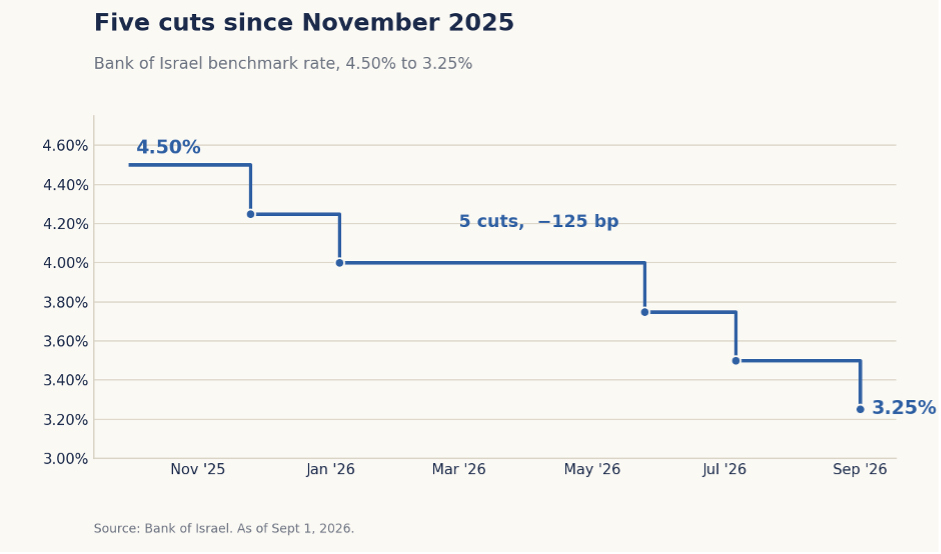
Figure 1. The benchmark rate has fallen 125 basis points across five cuts since November 2025.
The international contrast is striking: Israel keeps easing while the Federal Reserve stays focused on above-target inflation and the European Central Bank holds after raising rates in June. It would be easy to turn that divergence into a simple conclusion: Israel is cutting, so Israeli bond prices should rise.
That conclusion is directionally appealing, yet incomplete.
A rate cut does not move uniformly through the yield curve. It also impacts a long-only index, a hedged strategy and a dollar-based investor in different ways. Even within corporate credit, returns come from different aspects, including duration, spread, carry, security selection and market mechanics.
"Israel is easing" is therefore not, by itself, an investment thesis. The more useful question is which exposures should benefit, and which risks an investor actually wants to own. The short answer is that the cut most directly supports the front and intermediate parts of the local curve and selected corporate credit, while long-duration government bonds remain largely a bet on global rates. The rest of this article explains why.
Why the Bank of Israel cut
The Bank of Israel's decision was supported primarily by the domestic inflation picture.
Annual inflation stood at 1.5% in July, below the midpoint of the Bank's 1%–3% target range. Inflation excluding energy, fruits, and vegetables was also 1.5%, while expectations across most horizons remained close to the target midpoint. Israel's risk premium, as measured by credit-default-swap spreads, was close to its pre–October 7, 2023 level, at around 53 bps.
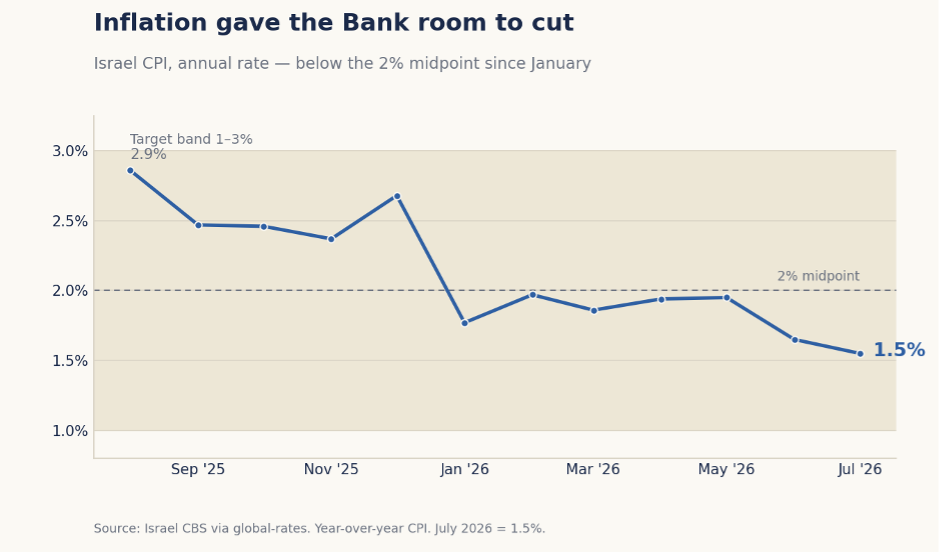
Figure 2. Inflation fell below the 2% midpoint in January and has stayed there, giving the Bank room to ease.
Growth was strong, though the headline overstates it. Second-quarter GDP rose at a 15.4% annualized rate, but most of that is the economy recovering from the first-quarter hit of Operation Roaring Lion. Measured against late 2025, and excluding Israeli companies' overseas production, domestic activity grew a steadier 3.8%. The first number captures the rebound; the second is the better read on the underlying pace.
Other indicators were mixed: the labor market stayed tight and wages kept rising, while business-survey balances lagged and fiscal uncertainty persisted around defense spending and deficits.
This was not emergency easing, nor a declaration that every risk had disappeared. It was normalization during a solid but uneven recovery where inflation had fallen far enough to let the Bank reduce the degree of monetary restraint.
The short end follows the Bank while the long end follows global trends and Israel-specific risks
Shorter-maturity government bonds are generally most directly connected to the expected path of the Bank of Israel's policy rate. If investors expect additional cuts or expect rates to remain lower for longer, short and intermediate yields should receive the clearest support. Even there, the relationship is not mechanical. A pre-priced cut may produce a minor rally. On the other hand, if investors think the Bank eased prematurely, rate expectations can rise instead.
Conversely, the long end answers to a broader set of forces. Ten-year Israeli yields reflect global real yields, term premiums and energy prices on one side, and Israel's own long-term risks on the other — the fiscal trajectory, sovereign issuance and the geopolitical premium — as much as the expected path of domestic policy.
The market since the decision has confirmed the point. As of September 2, the Israeli 10-year yield stood at about 3.84%, essentially unchanged on the cut and roughly 35 basis points lower than a year earlier, while the US 10-year rose to its highest level since November 2023. The result is striking: the Israeli 10-year now trades below the comparable US Treasury. That is a mark of confidence, not caution. It reflects Israeli inflation near 1.5% against roughly 3.7% in the US and a risk premium back to its pre-October-2023 level, the market's verdict on a recovering economy. The reason the long end did not fall further with the cut is simply global: domestic policy sets the front of the curve, while ten-year yields move with world rates. The effect is a steeper curve, not a judgment on Israel.
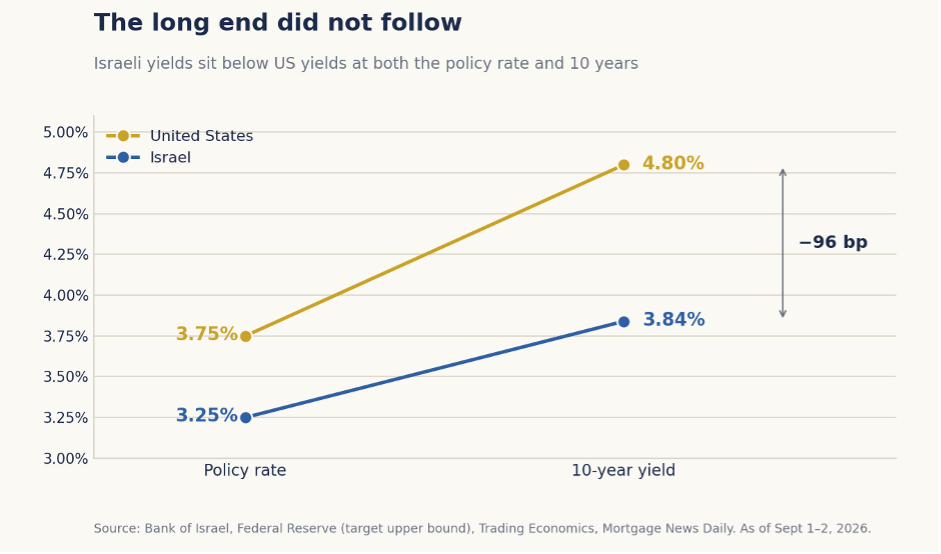
Figure 3. The front of the curve falls with the Bank; the long end, set by global rates and Israel's fiscal path, barely moved. The cut pays you in short and intermediate bonds — long duration is a bet on the world.
For investors, the implication, in our view, is straightforward: a constructive view on Bank of Israel policy is most directly a view on the local front and intermediate curve, not automatically a bullish call on long-duration government bonds.
Corporate credit has more than one return engine
Israeli corporate bonds are influenced by government rates, but they are not simply government bonds with additional yield.
Corporate bond returns can come from several distinct sources: the underlying government curve, credit carry, movements in credit spreads, issuer-specific selection and technical factors such as offerings, redemptions, index changes and institutional flows.
A cut can compress corporate spreads through two channels: (1) lower rates cut refinancing costs and default risk, which improves the fundamentals, and (2) as cash and deposits pay less, investors reach for yield in credit, and that demand bids up prices. Compression is not guaranteed though. A cut can read as a signal of weakness and instead widen spreads. However, in a normalization like this one, both channels push the same way.
But the benefit of compressing spreads will not be uniform across the issuance market. A company with near-term refinancing needs reacts differently from a cash-rich issuer; a long-duration investment-grade bond is dominated by the government curve, while a shorter or less-liquid issue is driven more by spread, carry and security-specific factors. An index rebalance can move a bond even when its creditworthiness has not changed.
For an active manager, those differences are the opportunity set. The goal is not merely to predict whether bonds will rise. It is to identify which source of return is mispriced and how much market, duration, credit and liquidity risk must be accepted to capture it.
The shekel as an additional lens to view the market
Everything so far has been about the bonds. But for a dollar-based investor, each Israeli bond carries a second exposure — the shekel — and it follows its own logic. The rate cut is a clean test of that logic.
A rate cut can, in theory, weaken the currency, and, as international investors in the Israeli capital markets, it helps to understand why. Holding shekels earns the Israeli rate, while holding dollars earns the US rate. With Israel now at 3.25%, below the Fed, that gap has turned against the shekel. Lower relative rates usually mean less demand to hold a currency in interest-bearing bank accounts.
However, it has not played out that way. A larger flow has run the other direction: Israeli institutions selling dollars to hedge their growing US equity holdings act as steady buyers for the shekel, and together with a normalized risk premium and Israel's strong external position, that has offset the easing rate effect. The shekel entered the decision near its strongest level of the year — about 3.02 per dollar, up roughly 5% year to date — and barely moved on the cut.
One would expect the cut to weaken the shekel, yet it sits near its highs. Just as the long end did not fall with the cut, and Israeli credit did not move with US spreads, the shekel remaining solid is another signal that local forces largely set the price.
A different cycle is not the same as decoupling
The easing cycle strengthens the diversification case for Israeli fixed income: local inflation, monetary policy, institutional flows, and market structure create return drivers that differ from those in the US and Europe.
But different does not mean independent. Long Israeli yields can still rise with global yields. Corporate spreads can widen during a worldwide risk-off event. Higher oil prices can affect both Israeli inflation and the global term premium.
The geopolitical escalation immediately following the Bank of Israel decision offered a real-time demonstration. On September 1 and 2, the United States and Iran exchanged fresh strikes near the Strait of Hormuz, Brent rose more than 4% to about $95 a barrel, and traffic through the strait fell sharply. Higher oil and higher global yields are precisely the forces that gave the Bank room to cut; their reversal is the first live test of the assumptions behind the decision.
The defensible diversification argument is not that Israeli bonds have separated from the world. It is that the market contains locally driven sources of return — particularly in shorter rates, corporate spreads, liquidity and relative value — that do not depend entirely on the direction of US duration or US credit.
This is clearest in credit, and it is worth being precise. Israeli corporate bonds are not fully decoupled from the world, as they share a global-duration factor with US bonds, so in sharp global rate moves they move together, as they did in 2022. But the sensitivity is low, and over time so is the correlation. Since 2011, Tel-Bond 60's monthly returns have carried roughly a 0.3 beta to the US Bloomberg Aggregate and a correlation near 0.3 — both under 0.2 before 2020. The higher readings since then reflect a post-COVID regime in which nearly all bonds traded as a single rates bet; structurally, Israeli credit is driven by local rates, credit and flows. That is the diversification — a low-beta stream on a different clock — not independence from global duration.
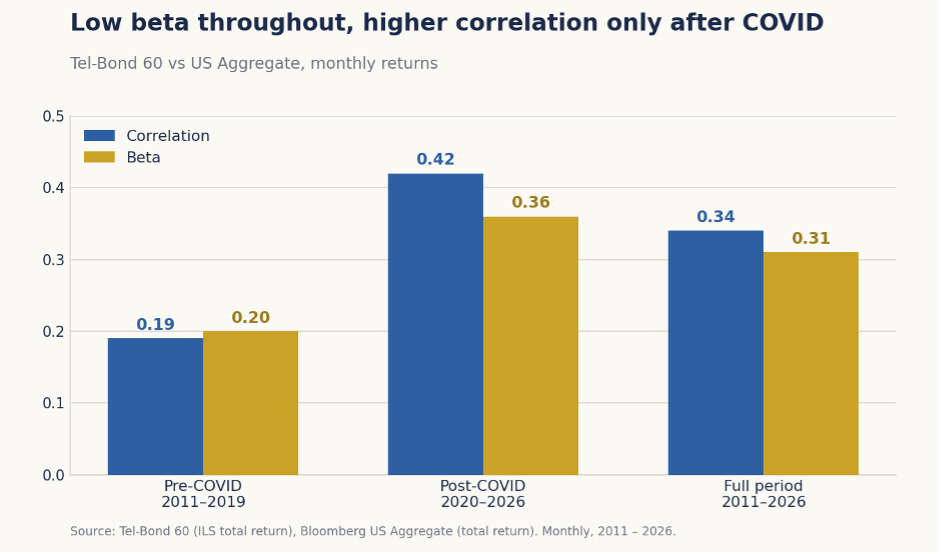
Figure 4. Beta to US core bonds has stayed near 0.3 for 15 years; correlation rose only in the post-COVID rates regime.
Diversification comes from owning different return drivers, not merely securities issued under a different flag.
The question investors should ask
The Bank of Israel's third consecutive cut matters. But its importance is not that it guarantees a broad rally across Israeli bonds.
The cut should provide the clearest support to the parts of the market most directly linked to domestic policy. Long-duration bonds remain exposed to global rates and fiscal risks. Long-only indices may outperform hedged strategies during clean beta rallies, while those same hedges may become valuable when the market reverses. Corporate-credit returns will continue to reflect spread, carry, liquidity and security selection — not merely the policy rate.
The most useful question is therefore not simply whether Israeli fixed income is attractive. It is which risks are producing the return, and whether those are the risks the investor intends to own. That is the distinction between following the rate decision and understanding the market it is moving through.
About Kotel Investment Management: We serve as a bridge between U.S. capital and Israel’s overlooked fixed income markets, sharing insights and perspective through our research and thought leadership.
This content is for informational and educational purposes only and does not constitute an offer to sell or a solicitation of an offer to buy any securities