From Payroll to Portfolios: How Israel’s Institutional Giants Were Built
(Part 1 of a series on Israel’s insurance and institutional-investment groups)

One of the first things you learn after moving to Israel is how to read a pay slip. Before most Israelis see their salary, part of it has already been set aside for retirement. The employee contributes to a pension arrangement, and the employer contributes alongside them and usually sets aside an additional amount toward severance. The Israelis I know treat this as an ordinary part of having a job. For an American reader, the closest comparison is Social Security: participation is required by law, and the money comes straight out of payroll. The difference is what happens next. Social Security taxes pay for current benefits through a government program, while Israeli contributions go into individual accounts that regulated financial institutions manage and invest and that grow over a worker's career. In that respect the system works like a 401(k) with an employer match, except that in Israel it is mandatory. Australia’s superannuation system, where employers must contribute 12% of wages, works on a similar principle.
That money flows into a pension fund, a provident fund, a training fund, or an insurance-based savings product, where one of a small number of Israeli financial groups invests it. From there it can end up in an Israeli government bond, a Tel Aviv-listed company, an infrastructure project, a private-credit fund, or the S&P 500.
Israel’s largest financial institutions — Phoenix, Harel, Migdal, Clal, Menora Mivtachim, Meitav, Altshuler Shaham — and their competitors did not become large mainly by producing better returns or buying rivals. Their rise came out of two decades of reform. The state restructured the pension system, broke the largest banks’ hold on household savings, and made retirement saving compulsory. The result is a system in which a handful of large managers invest most of Israel’s long-term savings.

Figure 1. The reforms that built Israel’s institutional investors, 1983–2008. Sources: see list at end.
Before the Giants
For most of Israel’s early history, the financial system was organized around three centers of power: the banks, the Histadrut, and the insurance companies. The banks dominated deposits, securities distribution, and business credit. The Histadrut, Israel’s national labor federation, controlled much of organized labor’s retirement saving through its affiliated pension funds. Insurance companies underwrote risk and sold some savings products, but they were not yet broad financial groups. Capital moved overwhelmingly through a concentrated system shaped by the government, the labor organizations, the banks, and a few large business groups. Open capital markets existed, but they played only a minor role in managing Israeli household savings.
The 1983 bank-share crisis, in which the major banks’ long-running support of their own share prices collapsed and the state took control of most of the banking system, showed the danger of letting the same institutions dominate credit, securities, advice, and household wealth. The reforms that addressed it took two decades to arrive, yet they shape much of the market we see today.
The 1995 Pension Reform
The first of those reforms came in pensions, where the immediate problem was solvency rather than concentration. Israel’s old pension funds were built on defined benefit promises: a member’s benefit depended on salary and years of service, not on an individually funded account. Over time, several of the large funds built up severe actuarial deficits. In 1995 the government closed the old funds to new members and created new comprehensive pension funds for incoming workers. These were funded and contribution-based, and benefits depended on what members paid in and what their investments earned.
The reform left two systems running side by side. On one hand, the old funds carried inherited promises and growing deficits. On the other hand, the new funds held growing pools of contributions tied to individual workers and ran on a commercial footing. They started small, but because their members were mostly young workers, the pools had a long horizon of monthly contributions ahead of them.
Separating Legacy from Growth
Closing the old funds to new members did not remove the deficits they had already built up. By the early 2000s, the government concluded that several of them could not meet their obligations without a major restructuring. In 2003 the state took control of eight troubled funds, placed them under special management, adjusted members’ rights, raised contributions, and committed assistance of about NIS 78 billion in 2003 values. Those funds are still administered together today under the name Amitim.
Moving the old liabilities into a separate, state-backed structure is what made the new funds sellable. Amitim carried the legacy promises and the state support attached to them. The new funds were left with clean balance sheets, a growing base of funded assets, recurring management fees, and contributions tied to employment and wages.
With the legacy problem ring-fenced, the state could sell the new funds, and the insurers were the natural bidders. In September 2004, Menora bought New Mivtachim, then Israel’s largest pension fund, and Migdal took over Makefet. Clal already ran a new fund of its own, Atudot. By the time Israel turned to its banks, the insurance groups were already becoming retirement-savings platforms rather than only underwriters of risk.
Bachar Breaks Up the Banks
Even after the 1995 pension reform, the banks remained at the center of the public’s investment system. Before 2005, Israeli banks controlled most mutual funds and provident funds. They manufactured the products, managed the assets, distributed them, and advised customers on what to buy, while also ranking among the largest lenders to Israeli business. The same bank could lend to a company, manage funds that bought that company’s securities, and steer customers into its own products.
The Bachar Committee, established in 2004 under Ministry of Finance Director-General Yossi Bachar, concluded that these functions had become too tightly combined inside Israel’s largest banks. The Bachar Committee’s recommendations became law through three statutes in July 2005. The core measure was mandatory divestiture: banks had to sell their provident-fund and mutual-fund management businesses. While they could keep advising customers and distributing products, they could no longer own and manage the funds they recommended. The banks still kept their customer relationships, branches, custody operations, and central place in the system, but they gave up direct control over much of the public’s managed savings.
The banks sold quickly, mostly to insurance groups, investment houses, and foreign and private-equity-backed buyers. The five largest banking groups’ share of long-term savings management fell from 52% in 2003 to 35% at the end of 2006 and 11% at the end of 2007, while the five largest insurance groups’ share rose from 21% to 55% (Figure 2 and Table 1). By the end of 2007, the banks had agreed to sell nearly all of their remaining provident funds. In mutual funds, banks had controlled about 80% of the market before the reform; by the end of 2006 their share was close to zero. Bachar did not create the money that would later fill the system. It created independent managers able to receive it.
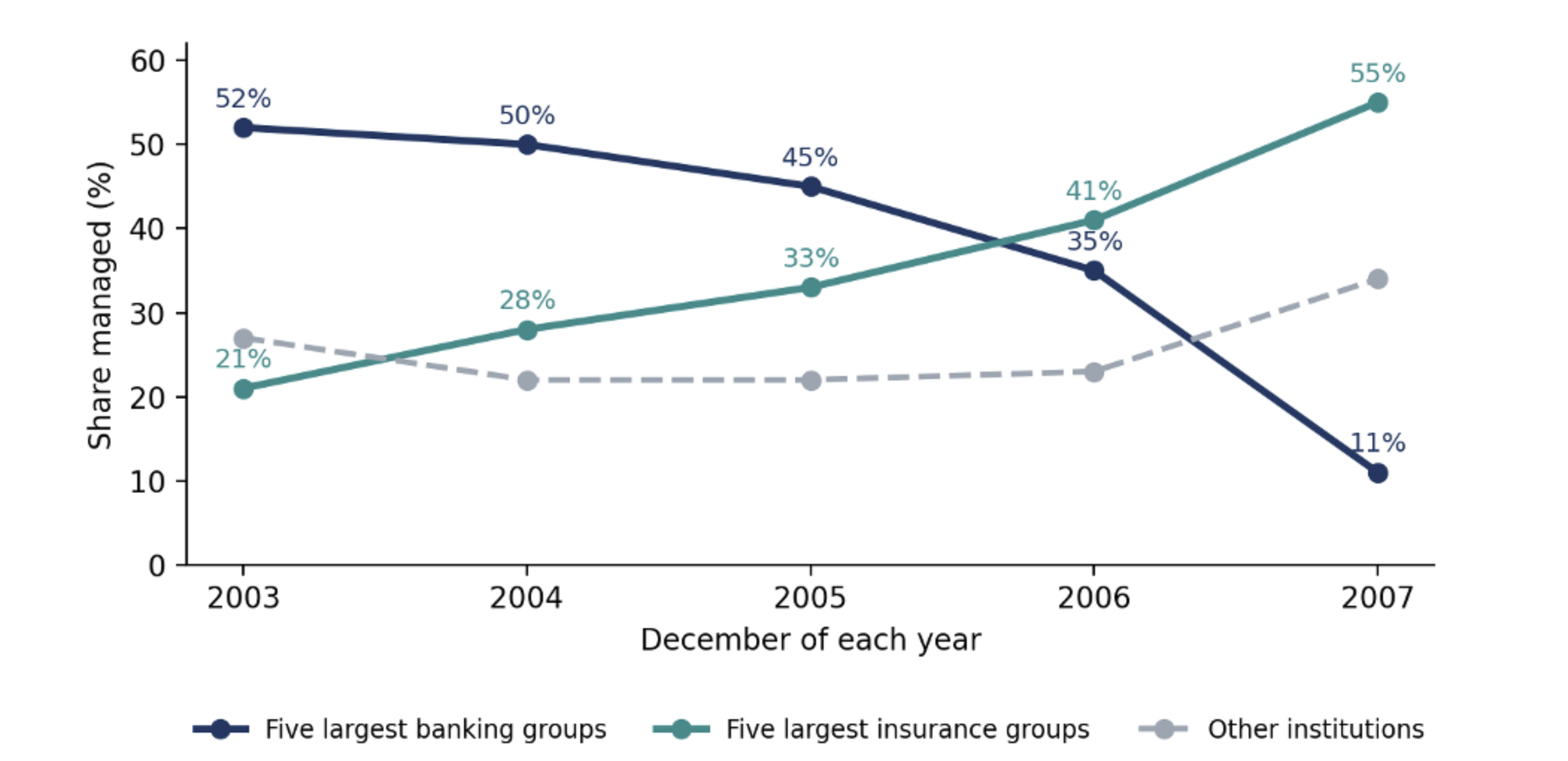
Figure 2. Share of Israel’s long-term savings managed by type of institution, 2003–2007. Long-term savings include with-profit life insurance, the new pension funds, provident funds, and training funds. Source: Bank of Israel, Annual Report 2007, Table 4.3.
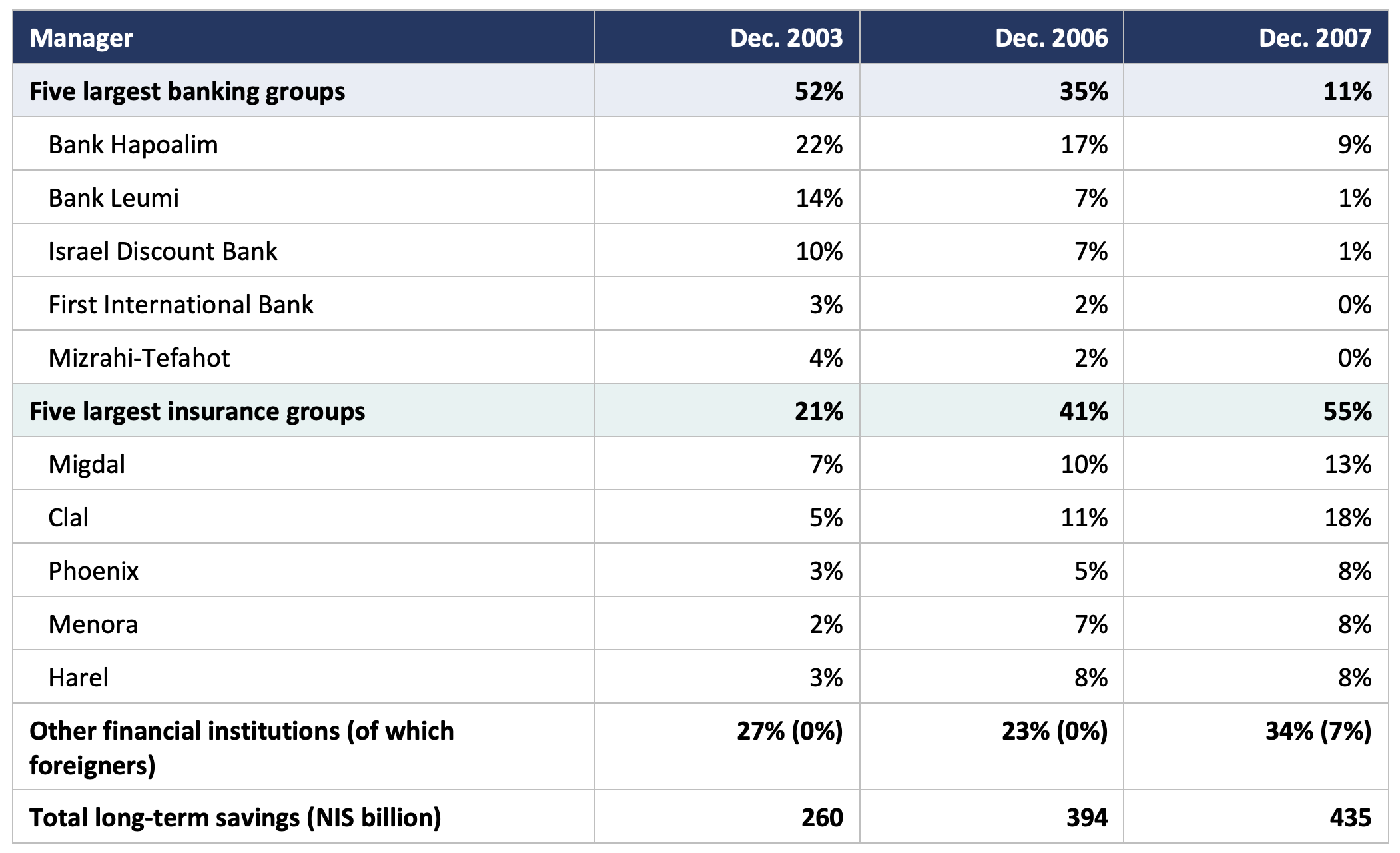
Table 1. Who managed Israel’s long-term savings before and after the Bachar reform (share of total). Figures are the Bank of Israel’s estimates and are rounded, so they may not sum to group totals. At the end of 2007 the banks had agreed to sell nearly all of their remaining provident funds, but some transfers were not yet complete; the Bank of Israel expected the banks’ share to fall to zero. Source: Bank of Israel, Annual Report 2007, Table 4.3.
Why the Insurers Won
The insurers were the natural buyers. They were already regulated and already inside long-term savings through their life-insurance books and new pension funds. Provident and mutual funds completed the platform: one group could now offer insurance, pensions, provident funds, training funds, and investment products, and manage the assets across all of them. Owning both underwriting and asset management gave them two sources of earnings, one tied to pricing risk and the other to recurring fees on a growing asset base. This is the origin of the modern Israeli insurance-led financial group.
Concentration Moved; It Did Not Disappear
Bachar achieved its immediate aim and removed specific bank conflicts. It also helped build Israel's corporate-bond and nonbank-credit markets; the Bank of Israel has since named the reform as a main driver of that growth. What it did not produce was a dispersed system. The Bank of Israel noted at the time that insurance companies’ control of long-term savings had intensified greatly, and it called for tougher supervision of them. Concentration moved from the banks to a small number of insurers and investment houses. Today nine groups manage more than 90% of Israel's pension savings, though concentration in savings remains well below banking, where the three largest banks hold 72% of the market.
Mandatory Pension Supplies the Inflows
Until 2008, a large share of Israeli workers had no funded occupational pension. Coverage was weakest among low-wage and younger workers, immigrants, and employees of small businesses. Beginning on January 1, 2008, pension saving became compulsory for eligible salaried workers. Employees now contributed a share of their wages, employers matched it, and a further employer contribution went toward severance.
The rates started low. Total mandatory contributions, including severance, began at 2.5% of wages in 2008 and rose in annual steps to 18.5% in 2017, where it remains: 6% from the employee, 6.5% from the employer toward pension, and 6% from the employer toward severance (Figure 3). That is the legal minimum. Many employers pay the full 8.33% severance component, which brings the total to 20.83%.
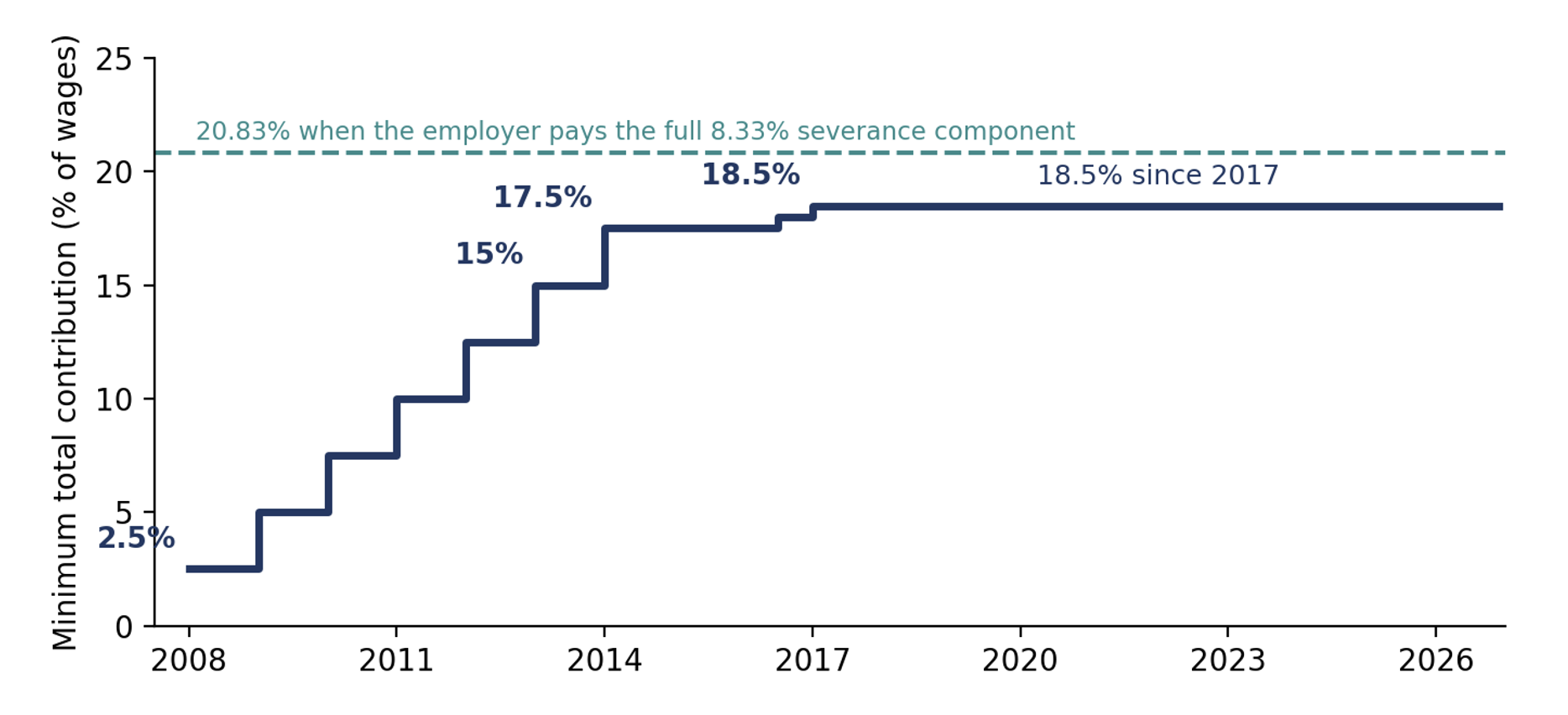
Figure 3. Minimum mandatory pension contribution, employee and employer combined, including severance. The rate has been unchanged since January 2017. Sources: Mandatory Pension Extension Orders; Ministry of Labor; OECD.
The effect on participation was immediate. Bank of Israel research found that about half of the employees who had not been saving for a pension in 2007 and stayed employed in 2008 began contributing; only about one-sixth of those not saving in 2006 had started in 2007.
What mattered most was the recurring flow. Every payroll period brings in new money, and for a relatively young fund, contributions exceed benefit payments for years. The managers do not have to win new clients each month to receive this capital; it arrives with the paycheck and stays for decades. Bachar had built the managers; mandatory pension filled their accounts.
From Savings Managers to Israel’s Largest Investors
As the pool grew, the money had to go somewhere. Israeli pension and insurance assets were historically channeled heavily into government bonds, much of it into non-tradable “designated” bonds with a guaranteed yield. Successive reforms reduced that reliance and gave the institutions room to invest in corporate bonds, equities, direct loans, real estate, infrastructure, private equity, and foreign assets.
The result is scale. At the end of March 2026, Israeli institutional investors managed about NIS 3.3 trillion, roughly 46% of the Israeli public’s entire financial asset portfolio. They are also the largest holders of Israeli government debt: of about NIS 503 billion in tradable government bonds held by the public, institutions held NIS 357 billion, or about 71% (Figure 4). Pension and provident funds alone held about 35% of all tradable government bonds at the end of 2024, against less than 10% for foreign investors.
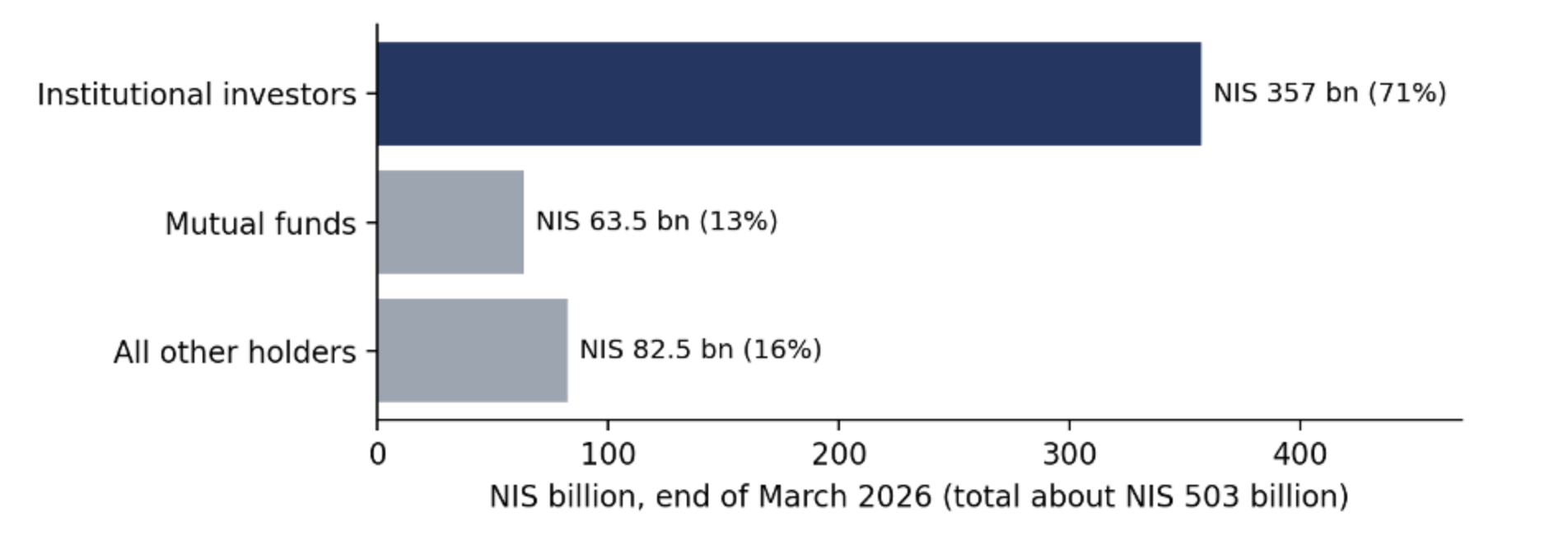
Figure 4. Holders of tradable Israeli government bonds held by the public, end of March 2026. “All other holders” is the remainder of the NIS 503 billion total. Source: Bank of Israel, The Public’s Financial Assets Portfolio, First Quarter of 2026.
The institutions do not own these assets. Pension and provident savings belong to members and sit in legally separate, regulated structures. The institutions are allocators, functionally asset managers: within their mandates and regulatory limits, they decide how much goes into government bonds, corporate credit, Israeli equities, foreign markets, real estate, infrastructure, private funds, and currency hedges.
That allocation power changed how Israeli companies borrow. Bank lending remained central, but large companies could now issue bonds or negotiate directly with institutional lenders holding long-duration capital. Tradable corporate bonds grew from 9% of Israel’s tradable bond market at the end of 2003 to 32% at the end of 2006, and provident funds, pension funds, and insurers already held about 44% of that corporate debt. The reform did more than move funds from one owner to another, as it created a class of nonbank institutions able to analyze, price, and hold corporate credit at scale. Those institutions became the anchor buyers that turned Israel’s public corporate bond market into a primary source of company funding.
The Banks Never Left
None of this made the banks irrelevant. They kept deposits, payments, mortgages, much of business lending, and relationships with nearly every household. They also became custodians, brokers, foreign-exchange dealers, and derivatives counterparties to the institutions that bought their old fund businesses. The system became less vertically integrated, but no less interconnected.
Why It Matters for Investors
By 2010, the foundations of today’s system were in place: the old pension funds ring-fenced under state-supported administration, new funded pension franchises largely owned by insurers, the banks out of fund management, and mandatory contributions from nearly the entire salaried workforce.
The most important legacy of these reforms is not that a few insurance companies grew large. It is that Israel built a mechanism that continuously turns household wages into financial assets. That mechanism creates steady demand for securities and helps finance the government and Israeli companies. Because the domestic market cannot absorb all of it, a growing share goes abroad.
For a foreign investor, that makes the institutions the first participants to understand in Israeli fixed income. Their allocation decisions affect the pricing of Israeli debt, the availability of nonbank financing, how much Israeli savings goes overseas, and, through currency hedging, the balance between shekels and dollars. They do not control the market on their own; government policy, the banks, foreign investors, and the Bank of Israel all matter. But their flows are large, recurring, and less discretionary than most investor money, which is what makes them structurally important.
The old Israeli financial system directed capital through the state, the Histadrut, and a handful of banks. The modern one routes a growing share through pensions, insurers, and investment houses. The concentration did not disappear. It moved.
Next in this series: who controls Israel’s savings today, and how the largest groups compare.
About Kotel Investment Management: We serve as a bridge between U.S. capital and Israel’s overlooked fixed income markets, sharing insights and perspective through our research and thought leadership.
This content is for informational and educational purposes only and does not constitute an offer to sell or a solicitation of an offer to buy any securities.
Sources
Amitim, “About,” amitim.com/en/about (accessed September 2026).
AustralianSuper, “Understanding the superannuation guarantee” (12% rate from July 1, 2025).
Bank of Israel, Annual Report 2006 and Annual Report 2007, Chapter 4: The Financial System.
Bank of Israel, Discussion Paper 2005.01 (insurance sector and financial stability); Adi Brender, “First Year of the Mandatory Pension Arrangement in Israel,” Discussion Paper 2011.05.
Bank of Israel, “The changing nature of the financial system in Israel,” BIS Papers No 148, Bank for International Settlements, September 2024.
Bank of Israel, “The public’s financial assets portfolio in the first quarter of 2026,” June 29, 2026.
Capital Market, Insurance and Savings Authority, Commissioner's Report 2024, Chapter 4, Chart D-3 (pension savings portfolio by group, December 2024, excluding veteran pension funds).
Capital Market, Insurance and Savings Authority, Commissioner's Report 2025 (concentration in savings versus banking).
Globes, “Menora Mivtachim leapfrogs top insurance rivals,” December 21, 2023; Globes, “Atudot Pension Fund beats Histadrut in Vishay pension tender,” February 10, 2004; Migdal Group, “Migdal Makefet.”
Israel Ministry of Finance, Accountant General, Government Debt Management Unit, Annual Report 2024.
Israel Ministry of Labor, “Right to Pension Insurance”; Mandatory Pension Extension Orders (2008, 2011, 2016).
OECD, Pensions at a Glance 2023: Country Notes – Israel.