(Part 2 of a series on Israel’s insurance and institutional-investment groups)

Part 1 described how Israel built a system that routes a fixed share of every salary into retirement savings funds managed by the country’s large financial institutions.
The question of who manages that money carries more weight in Israel than its American equivalent would. American asset management is concentrated too, but the relationship with the saver is not: it runs through more than 700,000 separate employer plans and the recordkeepers, custodians and investment managers they hire. In Israel nine financial groups hold the retirement account itself, through their licensed insurers and managing companies, and between them they hold almost all of the country’s long-term savings.
Before getting to who they are, it is worth being precise about what they manage. Israel’s savings products do not map onto American ones, and the vocabulary can cause much confusion.
The four accounts an Israeli worker holds
A typical Israeli employee holds two or three long-term savings accounts at once. Each has its own rules, its own tax treatment, its own degree of liquidity, and often its own manager. There are four products that matter.
The pension fund (keren pensia) is the core of the system and the one Part 1 described. Since 2008, every employee is entitled to one, and the contribution rate is set by law rather than chosen: 6% from the employee, 6.5% from the employer, and a further 6% of employer money set aside toward severance pay, for a standard total of 18.5% of salary. It is not a pure savings account. A pension fund also underwrites insurance, specifically disability and survivors’ coverage, for its members.
An American comparison would be a 401(k) with four features added: (1) the contribution rate is fixed by law rather than chosen, (2) the balance is not meant to be cashed out before 60 and early withdrawal is taxed punitively, (3) the payout is a lifetime annuity rather than a lump sum, and (4) the account carries group disability and life insurance. The Israeli pension fund does all four at once, unlike standard US retirement products.
The provident fund (kupat gemel) is a long-term savings account without the insurance component. It was once the main retirement vehicle in Israel, and still holds a very large stock of accumulated money, though new contributions mostly go to pension funds. A newer variant, the investment provident fund, takes voluntary deposits up to an annual ceiling and can be withdrawn at any time. In American terms these sit roughly where IRAs sit: accumulated retirement money, no insurance attached, held outside the employer’s main plan.
The training fund (keren hishtalmut) has no American equivalent. The employer contributes 7.5% of salary and the employee 2.5%. Within a monthly salary ceiling — NIS 15,712 in 2026 — the employer’s contribution is untaxed and the investment gains escape capital gains tax; above the ceiling neither holds. The money becomes liquid for any purpose after six years, or after three if it is spent on study. The training fund is the most efficient savings vehicle in the system because it is employer-funded, untaxed at both ends within the ceiling, and available well before retirement. Unlike pension cover, which is mandatory, a training fund is an employment benefit rather than an entitlement — standard in technology, finance and the public sector, required by some collective agreements, and far less common in low-wage employment. For this series the important feature is that the saver can move it between managers at any time, without waiting out the six years and without losing accrued seniority.
Insurance-based savings, usually sold as managers’ insurance (bituach menahalim) or participating life insurance, is a savings policy issued by an insurer. It bundles savings with life and disability coverage, and older policies lock in the rate at which the savings convert into a monthly pension — a guarantee newer products no longer offer, which is why many holders keep them. New sales have lost ground to pension funds for two decades, but the accumulated assets under management remain large.
Those four products are what Israeli employees choose between. What matters for the capital markets is who runs them, and how that money gets invested.
The nine firms that manage almost all of it
At the end of 2024, the Capital Market, Insurance and Savings Authority put the pension savings portfolio — excluding the closed veteran funds, which are explained further below — at 92% in the hands of nine managers. Five are insurance groups and four are investment houses. Everyone else shares the remaining 8%.
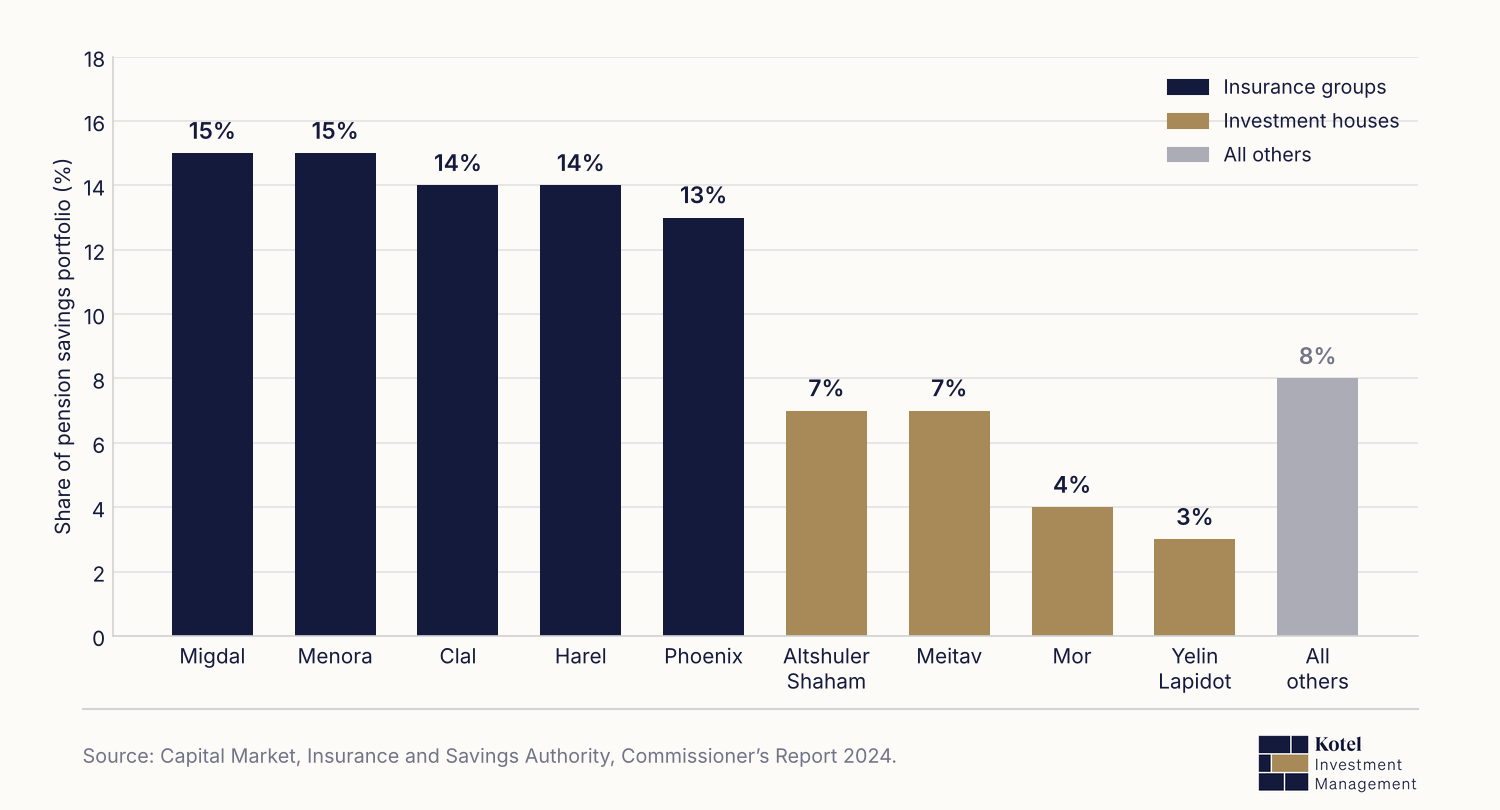
Figure 1. Share of Israel’s pension savings portfolio by group, December 2024, excluding the veteran pension funds. Source: Capital Market, Insurance and Savings Authority, Commissioner’s Report 2024, Chapter 4.
The pool is large and growing quickly. Israeli institutions held about NIS 3.43 trillion at the end of 2025, up from NIS 2.96 trillion a year earlier on market gains and continued net deposits. That figure covers both the savers’ money these firms manage and their nostro assets, meaning capital invested from the institution’s own balance sheets, which matters mainly for the insurers because they hold reserves against the policies they have written. Of the total, about NIS 1.6 trillion sits in pension funds, NIS 1 trillion in provident and training funds and NIS 660 billion in insurance-based savings. The balance is in the insurers’ nostro investments and other assets outside those three categories.
The nine divide into two groups that behave differently, which is the distinction that matters most to a foreign investor.
The five insurance groups
Migdal, Menora Mivtachim, Clal, Harel and Phoenix each manage between 13% and 15% of the pension savings portfolio.
The large Israeli insurance companies dominate Israel’s retirement savings.
There are two main reasons. The primary reason is operational: the insurance companies already hold the key ingredients for a pension business — actuaries, decades of experience investing long-term money, and a national network of sales agents.
The second reason is structural: the insurance companies were the buyers when the state and the banks sold, which is the history Part 1 explored. The old Histadrut pension funds were closed to new members in 1995, and new funds opened alongside them. When the state stepped into the deficit-ridden legacy funds, it kept those under special management — they are the funds Amitim runs today — and sold the new ones instead. In September 2004 Menora paid NIS 710 million for New Mivtachim, Migdal NIS 201 million for New Makefet and Clal NIS 135 million for Meitavit, about NIS 1.05 billion in all.
The following year the Bachar reform forced the banks to divest their provident and mutual fund businesses, and the insurers bought much of what came to market. Israel’s insurance groups became large asset managers in two waves of purchases, inside about eighteen months. Those purchases established the insurance groups as the dominant managers of Israel’s long-term savings, and they are why the distribution still runs through agents and employers — a network no investment house has matched.
The four investment houses
The four main investment houses — Altshuler Shaham, Meitav, Mor and Yelin Lapidot — hold between 3% and 7% of the market each. Three of them run pension funds of their own, so the divide between the two groups is one of emphasis rather than of permission.
"Investment house" (beit hashkaot) means something specific in Israel and has no clean American corollary. Israeli investment houses run mutual funds, manage money directly for clients, operate retail brokerage services and administer retirement accounts — all under one roof and brand. The nearest single-firm comparison in the U.S. is a Fidelity or a Schwab, though the scale is not comparable.
Unlike the insurance companies, the investment houses do not underwrite insurance. They compete on fees and published investment performance, and they grew because savers and employers actively chose to move money to them.
Their route into pension was opened by the regulator. Under the mandatory retirement savings regime, every Israeli employee is entitled to a pension arrangement — either a pension fund, a provident fund or a managers’ insurance policy. However, many savers do not specifically choose which arrangement they want, and neither do their employers, so someone else decides where the money goes. Until 2016 that was the employer’s insurance agent — who was paid a commission by the fund that received it, which put the agent’s incentive and the saver’s interest on different sides.
In 2016 the Authority took that decision away from the agents and auctioned it instead. Pension funds bid for the right to be a default fund — one a worker is enrolled in automatically. The bids the pension funds make are on fees: a cap on what they may charge against accumulated savings, and another against each new contribution. In the round that began in November 2024 those caps were 0.22% of accumulated assets and 1% of contributions. The selection runs four years, but a saver who joins keeps the fees they were given for ten — so each round leaves a decade-long price commitment behind it.
Meitav Dash and Halman Aldubi won the first tender in 2016. Altshuler Shaham and Psagot joined about two years later. Mor and Infinity came in through the 2021 round, which picked the same four — Meitav, Altshuler Shaham, Mor and Infinity — that won again in 2024. No insurance company has ever won one.
That absence is not hard to explain. Winning means selling at a fee far below what your existing members pay, through a channel built to bypass the agents your distribution depends on. For a firm with no pension book to protect, it was a way in. For a firm with a large one, it threatened the business it already had. Fees fell across the whole market anyway, not only at the winning funds: at Phoenix, the average fee on accumulated savings halved, from 0.32% in 2014 to 0.16% by the end of 2023.
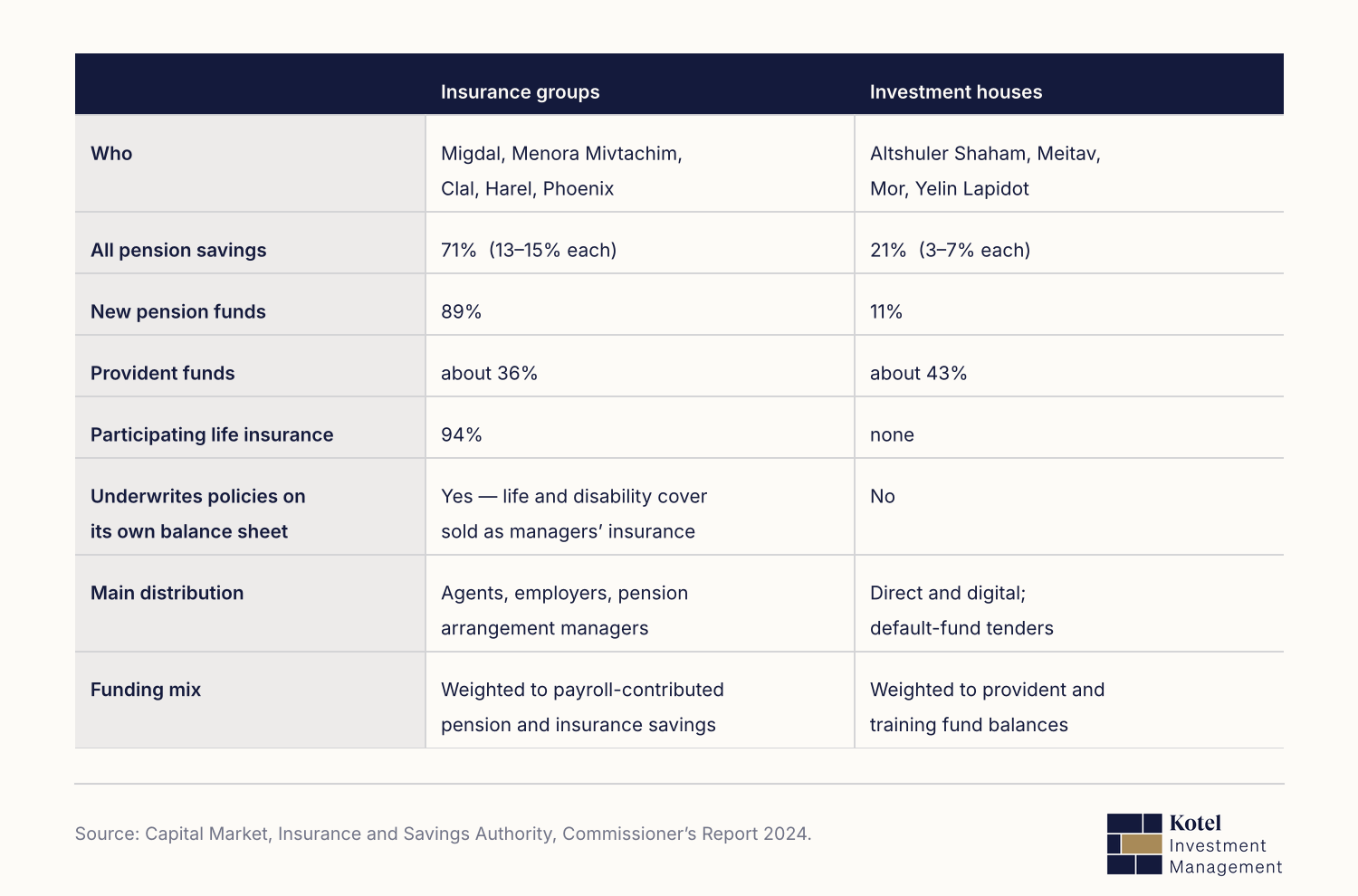
Table 1. The two kinds of manager. All shares are at December 2024; pension savings excludes the veteran pension funds, and provident fund shares are rounded. Source: Capital Market, Insurance and Savings Authority, Commissioner’s Report 2024, charts ד3–ד6.
Why each group holds the money it does
The Authority publishes market share by product, and the breakdown is informative. The insurers dominate what is hardest to move: the new pension funds, where Menora alone holds 28% of the market, and participating life insurance, where Migdal holds 30% and Phoenix 22%. The investment houses lead in provident funds, where Altshuler Shaham is the largest manager at 15%.
The ownership pattern follows how easily savers can enter and leave each product. Fees and investment performance matter as well, and savers have the legal right to pick and change their manager in every one of these products — what differs is how many of them use it. For an employee, a pension fund is bought once, usually at a new job, and often by default; changing it means changing an insurance arrangement as well as an investment account, and the decision is frequently made by an employer or an agent rather than by the saver. A training fund is the opposite: liquid after six years, no insurance attached, easily moved with a form by the saver alone.
So in practice the customer is different in each case — a pension fund is usually settled by an employer or an agent with the saver’s passive consent, while a training fund is moved by the saver alone. The insurers built agent and arrangement networks, the investment houses built advertising, digital onboarding and published performance, and each won the product its channel could reach.
The pattern is a fact about the products rather than about the firms. Pension and insurance-based savings arrive through payroll, carry insurance, and are costly to unwind. Provident and training fund balances move on a form. Insurance groups are weighted toward the first set and investment houses toward the second, so their asset bases do not behave alike in aggregate. That is not a property of the managers themselves: three investment houses run pension funds, and several insurance groups own mutual fund managers, including the largest of them.
Who is not among the nine
Four groups sit outside this list. Each either used to be in the business, sits in an adjacent business, or holds the equivalent position in other countries.
As described in Part 1, the banks no longer manage long-term savings, after the asset management businesses left them in the 2005 divestiture.
The veteran pension funds are excluded from the figures above because they are closed to new members. These are the pre-1995 defined-benefit funds, shut in the 1995 reform and now administered by Amitim, which held about NIS 409 billion at the end of 2024. Existing members still contribute, but the funds take no new entrants, which makes Amitim a large pool of long-term Israeli savings sitting entirely outside the nine.
Mutual funds are a separate pool and a separate question. They are retail money, they are liquid, and the banks can still distribute them. They are not in the long-term savings figures above and they are not what Israelis mean by "the institutions." They are, however, a very large holder of Israeli credit, which is the subject of the last section.
Foreign asset managers are also absent from this business. The global investment banks with presence in Israel run corporate finance, research and trading operations. AllianceBernstein, for example, has an office there serving private wealth clients, and the global index firms sell the funds Israeli portfolios buy. Foreign capital even owns pieces of the nine institutions: Phoenix was controlled from 2019 by two US private equity firms, Centerbridge Partners and Gallatin Point, which sold most of their stake down in 2024.
What no foreign firm does is hold the saver relationship. The managing companies licensed to run pension, provident and training funds are Israeli entities supervised by the Authority, and global managers reach Israeli retirement capital through them, on mandates the nine award. In the United States the large asset managers supply the funds inside a system of employer plans, recordkeepers and custodians. In Israel the savings relationship itself sits with the nine, so an issuer or manager who wants Israeli retirement capital deals with the nine directly.
Why the concentration matters
Concentration in savings management is not the same as concentration in the markets those savings reach, and the distinction is worth holding. At July 2026 institutional investors as a category — a wider group than the nine — held 33.7% of Israel’s tradable corporate bonds, while the mutual fund industry held 47.9%. An issuer coming to Tel Aviv is marketing to a short list of institutional buyers and to a fund industry of about NIS 800 billion. The two sides also overlap: the three largest fund managers in mid-2026 were Kesem, which belongs to Phoenix, together with Meitav and Harel. Several of the nine therefore run locked-up retirement money on one hand while managing daily-liquidity funds on the other.
What the concentration does mean is that a small number of groups decides where a very large share of Israel’s long-term savings is invested. The institutional sector managed about NIS 3.43 trillion at the end of 2025. Of the pension savings portfolio within that — the part still open to new members — the nine hold 92%. How much of it stays in Israel, how much goes abroad and which assets they favour are decisions that reach well beyond the retirement system. Because the money arrives through payroll, they are decisions that get made again every month, in good conditions and bad.
Part 1 ended on the observation that concentration in Israeli finance moved rather than disappeared — out of the banks and into the nine. This is where it went, and the consequence runs further than the retirement system. A mandatory savings regime takes a fixed share of almost every Israeli salary and hands the investment decision to nine firms. They do more than administer accounts: they determine where the country’s long-term savings are put to work, and on what terms capital reaches Israeli businesses and markets.
Who controls the money is the starting question. What they do with it is the next one.
Next in this series: what the institutions do with the money, and why they have been buying fewer bonds.
About Kotel Investment Management: We serve as a bridge between U.S. capital and Israel’s overlooked fixed income markets, sharing insights and perspective through our research and thought leadership.
This content is for informational and educational purposes only and does not constitute an offer to sell or a solicitation of an offer to buy any securities.
Sources
Capital Market, Insurance and Savings Authority, Commissioner’s Report 2024, Chapter 4 (pension savings portfolio by group, December 2024, excluding the veteran pension funds; market shares by product).
Capital Market, Insurance and Savings Authority, Commissioner’s Report 2024, Chapter 3, section 3.5.1 — institutional assets of about NIS 2.96 trillion at December 2024, against NIS 2.59 trillion at the end of 2023, of which about NIS 2.74 trillion is the pension savings portfolio.
Capital Market, Insurance and Savings Authority, Commissioner’s Report 2025 (total assets under management at the end of 2025, market shares by group, portfolio composition 2020–2025).
Calcalist, March 17, 2026 — Kesem, the mutual fund manager owned by Phoenix, the largest in Israel with NIS 122.5 billion at the end of 2025.
Amitim, “About,” amitim.com/about (accessed November 2026) — the veteran funds’ membership and assets of about NIS 400 billion.
Bank of Israel, Annual Report 2007, Chapter 4: The Financial System (the Bachar divestiture).
Bizportal and Calcalist reporting on the selected (default) pension fund tenders, 2016–2024 — winners by round, the four-year term from November 2024 and its fee caps of 0.22% of assets and 1% of deposits, and fee levels at Phoenix.
Bizportal, “Keren Hishtalmut 2026” (training fund contribution rates, the NIS 15,712 monthly salary ceiling for the tax benefit, and the six-year and three-year liquidity rules).
Israel Ministry of Labor, “Right to Pension Insurance” (mandatory pension extension order, contribution rates, regulated maximum management fees).
Israel Tax Authority and Ministry of Labor guidance on provident funds, investment provident funds and training funds (contribution rates, deduction ceilings, capital gains treatment, six-year liquidity).
Globes and TheMarker reporting on the September 2004 privatization of the new pension funds — Menora–New Mivtachim at NIS 710 million, Migdal–New Makefet at NIS 201 million, Clal–Meitavit at NIS 135 million — and on the legacy deficit funds remaining under special management.
Globes, July 16, 2024, “Centerbridge and Gallatin sell control of Phoenix” (US private equity control of Phoenix from 2019 and the 2024 sell-down).
AllianceBernstein corporate locations, alliancebernstein.com (AB Bernstein Israel Ltd, Tel Aviv), accessed October 2026.
Bank of Israel, holders of tradable bonds, July 2026 (institutional and mutual fund shares of tradable corporate bonds; the mutual fund series resumed in May 2025, monthly from January 2020).
Maariv, March 5, 2026 (mutual fund industry at about NIS 800 billion; passive, money-market and active split); Bizportal, August 6, 2026 (largest fund managers by assets, end-July 2026).