(Part 5 of the History of Israeli Capital Markets Series)

At the end of 1984, Israel’s economy was close to collapse. Part 4 of this series described how a decade of war spending, oil shocks and deficits financed by printing money had taken their toll. Inflation reached 445% a year, and public debt reached 284% of GDP. The 1983 bank shares crisis had collapsed the share prices of the country’s largest banks and left the government owning most of the banking system.
Two years later, inflation was below 20%. This part tells how that happened, and how it began the shift toward the capital market Israel has today.
An Election Without a Winner
Nine months after the bank shares collapse, Israel held elections on July 23, 1984. Shimon Peres’s Labor-led Alignment won 44 of the 120 seats in the Knesset, Israel’s parliament, and Yitzhak Shamir’s Likud won 41. Neither could assemble the 61 seats needed to govern, so in September the two rivals formed a national unity government, with Peres as prime minister for the first two years and Shamir for the next two.
The arrangement made economic reform politically possible. Observers at the time noted that the measures needed to stop inflation would expose any narrowly based government to mass protest led by the opposition. With both major parties in the cabinet, there was no large opposition left to lead one.
Living With Triple-Digit Inflation
By 1984, prices were rising about 15% a month, enough to double them roughly every five months. By the end of the year, the Bank of Israel had issued a 10,000-shekel note. At that pace, anyone who held shekels for even a few weeks lost money.
Israelis protected themselves by linking their income and savings to prices, a practice economists call indexation. Wages were topped up with cost-of-living payments as often as monthly. Savings sat in accounts linked to the price index or to the dollar, including dollar-linked deposits known by their Hebrew acronym, PATAM. The government adjusted the exchange rate to keep pace with prices.
These arrangements protected people from inflation, but they also kept it going. The result was a vicious cycle. A devaluation of the shekel raised import prices. Higher prices triggered higher wages. Higher wages raised costs, which called for another devaluation. And because the government paid for its deficit by borrowing from the central bank, there was always new money to fund the next round.
In late 1984, the economists Michael Bruno and Stanley Fischer described the problem as the economy not having a nominal anchor. In a stable economy, some important price holds still, such as a fixed exchange rate, and other prices adjust around it. In Israel, every price was tied to every other, so nothing held inflation in place once it rose.
The new government’s initial attempt to stop the spiral was to strike an agreement. Between November 1984 and July 1985, it negotiated a series of “package deals” with the Histadrut, Israel’s labor federation, and with employers. The first brought monthly inflation down to about 4–5% for a short time. But the deals froze wages and prices without fixing the deficit behind them, and by the spring of 1985 inflation was back to about 14% a month.
The Economic Stabilization Plan
On July 1, 1985, the government adopted the Economic Stabilization Plan. It was designed by a small team headed by Emanuel Sharon, Director General of the Finance Ministry. Its central idea was to stop everything at once.
The plan started with the budget, because the deficit was where the new money came from. The government cut about $1.25 billion a year from spending. Subsidies that had held down the prices of basic goods were reduced, and those prices rose by 30% to 100% at once. Defense spending was trimmed, and 10,000 civil servants were to be dismissed.
Taxes also went up. Lowering inflation raised revenue too, without any new tax. The reason is timing: taxes are paid weeks or months after the income or sale they are based on. With prices rising 15% a month, a tax bill of 1,000 shekels paid three months late was worth only about 660 shekels in buying power by the time the government received it. Inflation was eroding about a third of that revenue. Once inflation slowed, the erosion largely stopped, and the same tax bills were worth close to their full value.
On July 1, the same day the plan took effect, the shekel was devalued by 18.8% and then held at about 1,500 shekels per dollar (1.5 in the new shekels introduced that September). After years of repeated adjustment, the FX rate was held fixed. That mattered because import prices, and through them wages and much of the price index, had moved with every devaluation; fixing the FX rate removed the trigger for each new round. A special U.S. grant of $1.5 billion over two years added to reserves and made the commitment more believable.
A fixed exchange rate could not survive if wages kept rising, so the plan froze wages as well. Freezing wages required the agreement of the Histadrut, since its contracts set the pay of most Israeli workers. The federation opposed the cuts at first, and a one-day general strike in early July idled an estimated 80% of workers. It then agreed to a temporary freeze, giving up automatic cost-of-living payments in exchange for a one-time 14% raise. Most prices were also frozen. Real wages fell 7% in 1985, and workers bore much of the plan’s immediate cost.
Finally, the plan closed the channel that had turned deficits into new money. An amendment to the Bank of Israel Law, passed in 1985 as part of the program and known as the No-Printing Law, barred the central bank from lending to the government to finance its budget deficit. From then on, the government had to raise taxes, cut spending or borrow from investors.
A New Currency
Two months later, the currency itself changed. On September 4, 1985, the new shekel replaced the old one at 1,000 to 1. A liter of milk that had cost about 280 shekels now cost 28 agorot, or hundredths of a new shekel.
Removing zeros does not change anything real by itself. Every price, wage, savings balance and debt was divided by 1,000 on the same day, so no one became richer or poorer. The change was partly practical, since figures had grown hard to work with, and partly a clean break with a currency tied to inflation.
Israel had already seen that a new currency alone was not enough. The old shekel had replaced the Israeli pound only in 1980, and it lost almost all its value within a few years. This time the budget cuts and the wage freeze came first. The new shekel remains Israel’s currency today and has not been redenominated since.
The Results
The results came quickly. July itself saw a one-time price jump of 27% as the devaluation and subsidy cuts worked through. After that, monthly inflation fell to an average of 2.7% for the rest of 1985 and about 1.5% in 1986. Annual inflation, measured December to December, fell from 445% in 1984 to 188% in 1985 and 18% in 1986.
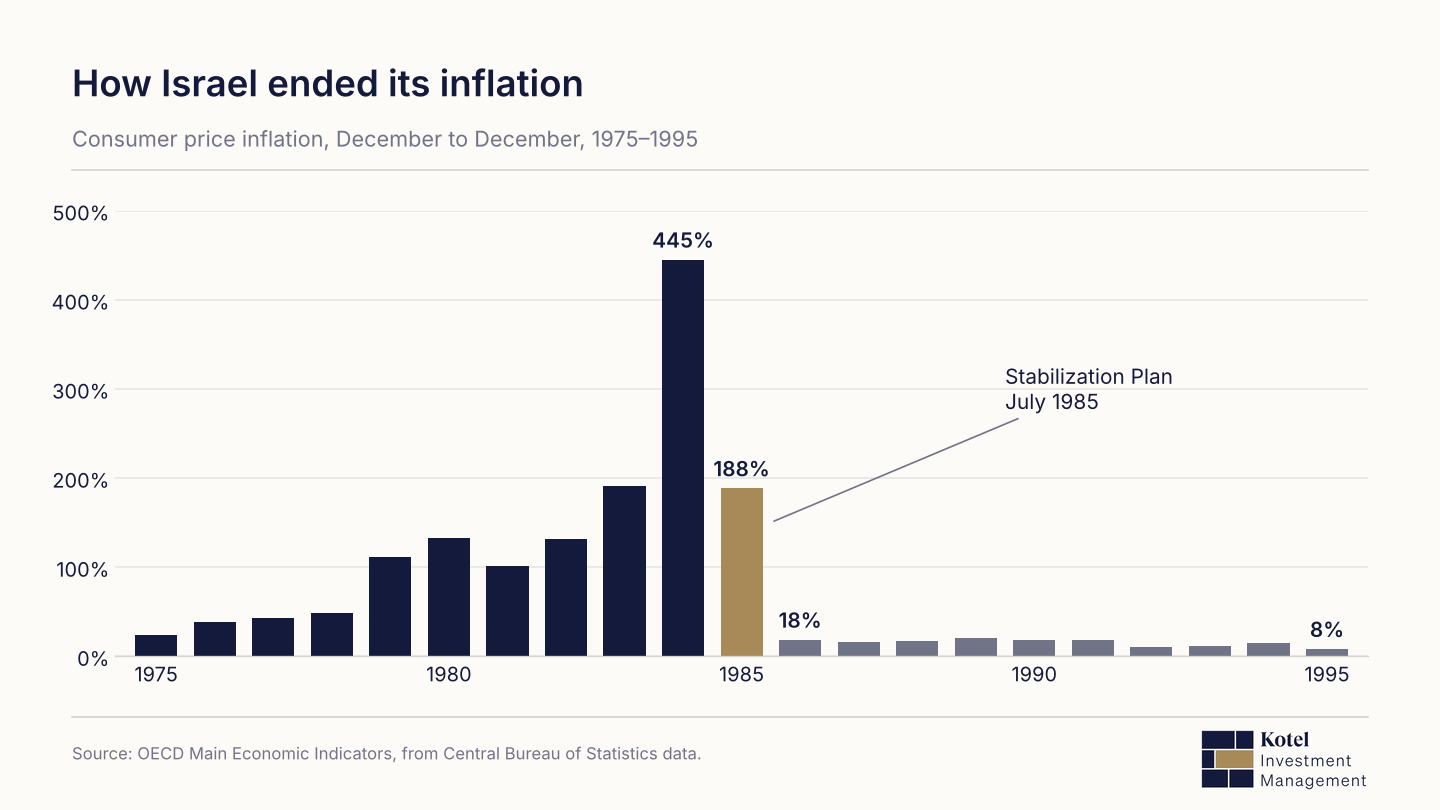
The plan worked where the package deals had not because it dealt with the deficit and the spiral at the same time. Bruno stressed that halting wages, prices and the exchange rate on the same day left no part of the economy catching up with the others. Stanley Fischer put more weight on the budget cuts, which he called the plan’s foundation. Fischer, an MIT economist, advised U.S. Secretary of State George Shultz on the program and later became Governor of the Bank of Israel and Vice Chair of the U.S. Federal Reserve.
The public finances turned just as fast. The domestic budget deficit fell from 16% of GDP in 1984 to about 1% in 1986–88, and public debt fell from 284% of GDP at the end of 1984 to 199% at the end of 1985. Savings also began to move from dollar-linked accounts back into the shekel.
There were also costs. Unemployment rose from 6.2% to a peak of 7.8% in the third quarter of 1985 before easing, and borrowing was very expensive for months. Nor did the plan finish the job. Inflation stayed between roughly 10% and 20% a year until the mid-1990s, a story Part 6 picks up.
The State Steps Back
The years after stabilization also saw the state begin to retreat from owning the economy. In 1985, the economy was heavily nationalized, as the government owned most of the banks, along with companies in industry, energy, transport and communications. The Histadrut’s holding company, Hevrat HaOvdim, owned a large share of the business sector; at its peak, its businesses employed close to a quarter of Israel’s workforce. Over the following decades, both sold off much of what they owned.
For the Histadrut, the retreat began with a crisis. Its largest industrial group, Koor Industries, lost $253 million in 1987, and by late 1988 it was close to bankruptcy with about $1.2 billion of debt. When Koor missed a loan payment, its American lender, Bankers Trust, went to court to have the company liquidated. Koor survived by cutting its workforce by 40% and handing equity to its creditors. In 1994, a new Histadrut leadership began selling the federation’s remaining businesses, and in 1995 it sold its last stake in Koor.
The government moved more slowly. By early 1990, it had sold stakes in only eight companies, worth about $300 million. A plan to sell half of Israel Chemicals had stalled after the Knesset Finance Committee deemed the company a vital national asset that should stay in government hands. The largest sales came later. In 1997, the state sold control of Bank Hapoalim, the country’s largest bank and a Histadrut institution before 1983, to a group led by Ted Arison for about $1.4 billion, then the largest privatization in Israel’s history. The state’s last significant holding from the 1983 takeover, about 5.4% of Bank Leumi, was sold to Citigroup in 2018.
The new owners of these companies, and the business groups they built, are a subject for a later part of this series.
From Funding the State to Funding Companies
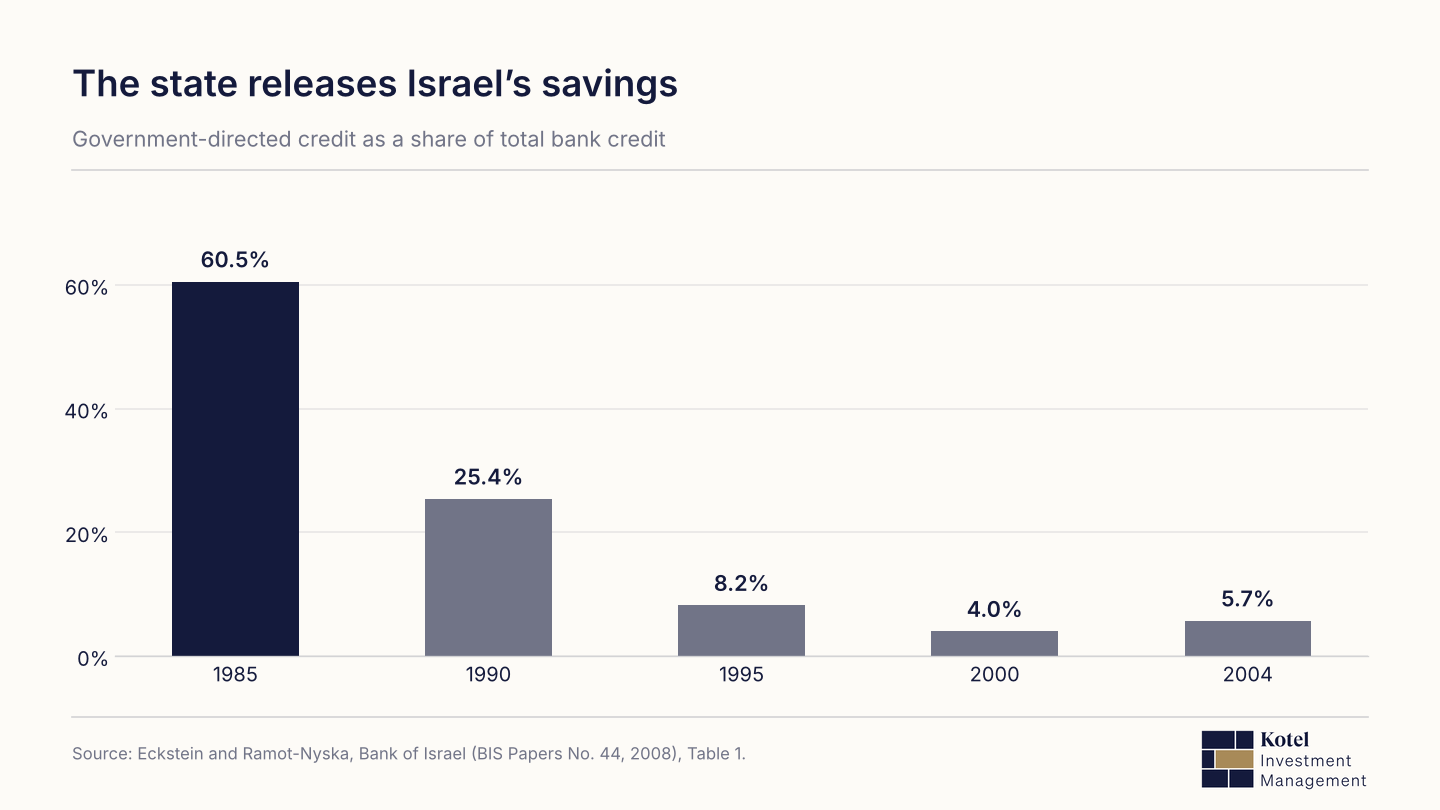
For a series about capital markets, the change in how Israel’s savings were used may be the plan’s most important consequence. A capital market needs savers who are free to choose what to buy, and before 1985 Israel’s largest savers were not. Institutional investors such as pension funds and provident funds (tax-advantaged savings plans) were required to put 95% of their new money each year into special government bonds that could not be traded. Companies faced limits on issuing their own bonds, and the government directed most bank credit. A state running a domestic deficit of 16% of GDP needed every source of funding it could find.
Once the deficit was under control, the state no longer needed to claim as much of that money, and from 1987 it began to let it go. The limits on companies issuing their own bonds were removed. The share of savings that had to go into the special bonds was cut in stages through 2003, and institutions were gradually freed to invest elsewhere. Foreign-exchange controls were lifted over the same period. Government-directed credit fell from 60.5% of bank credit in 1985 to 4% in 2000. Savings that had once gone to the state by rule could now be lent to companies, the precondition for the corporate bond market Israel has today.
Why It Matters for Investors
Three features of today’s Israeli market trace back to 1985.
The first is an effective, independent central bank. Before 1985, the Bank of Israel could be used to finance the government’s deficits. The No-Printing Law ended that and left the Bank free to focus on prices. In the years that followed, it moved to formal inflation targets, a story Part 6 tells, and the principle was carried into the Bank of Israel Law of 2010. Since 1985, Israel has funded its deficits by borrowing from investors, not by borrowing directly from the Bank of Israel. That independence is one foundation of the credibility investors price into Israeli government bonds.
The second is a habit of fiscal discipline. The plan showed that Israel could cut a domestic deficit of 16% of GDP to about 1% within a few years. That record, built on in later decades, helps explain why the economy absorbed later shocks, from the 2001–2003 recession to the 2008 global crisis, without returning to the instability of the early 1980s.
The third is the capital market itself, which grew once the government stopped claiming most of the country’s savings. The inflation years also left a lasting mark: about 47% of the government’s debt was still linked to the consumer price index at the end of 2025, according to the Ministry of Finance.
Next up: Part 6, the 1990s — immigration from the former Soviet Union, the growth of the technology sector, and the move to inflation targeting.
Earlier in the series: Part 1: Why History Matters · Part 2: From Settlement to Statehood · Part 3: Statehood and Austerity · Part 4: The Lost Decade
About Kotel Investment Management: We serve as a bridge between U.S. capital and Israel’s overlooked fixed income markets, sharing insights and perspective through our research and thought leadership.
This content is for informational and educational purposes only and does not constitute an offer to sell or a solicitation of an offer to buy any securities.