One Shock, Different Reactions: France, Israel and the Global Bond Selloff

France's government bond market has been in the news. On October 1, the French 10-year government bond yield rose above 4.9%, its highest level since July 2002. The spread over German Bunds reached roughly 130 to 140 basis points, the widest since the 2011–2012 euro-area debt crisis and now wider than the spreads on Italian and Greek debt. In February, the same spread was about 55 basis points.
France was not alone. In the third quarter, a global shock hit bond markets. Higher oil prices following the Iran war raised inflation expectations and set off a worldwide selloff in government bonds. US 10-year yields rose 0.83%, the largest quarterly increase since 1994, while French and Italian yields rose 1.29% and 1.28%. Germany, the United Kingdom, and Canada, all with lower debt ratios than the US, saw smaller moves.
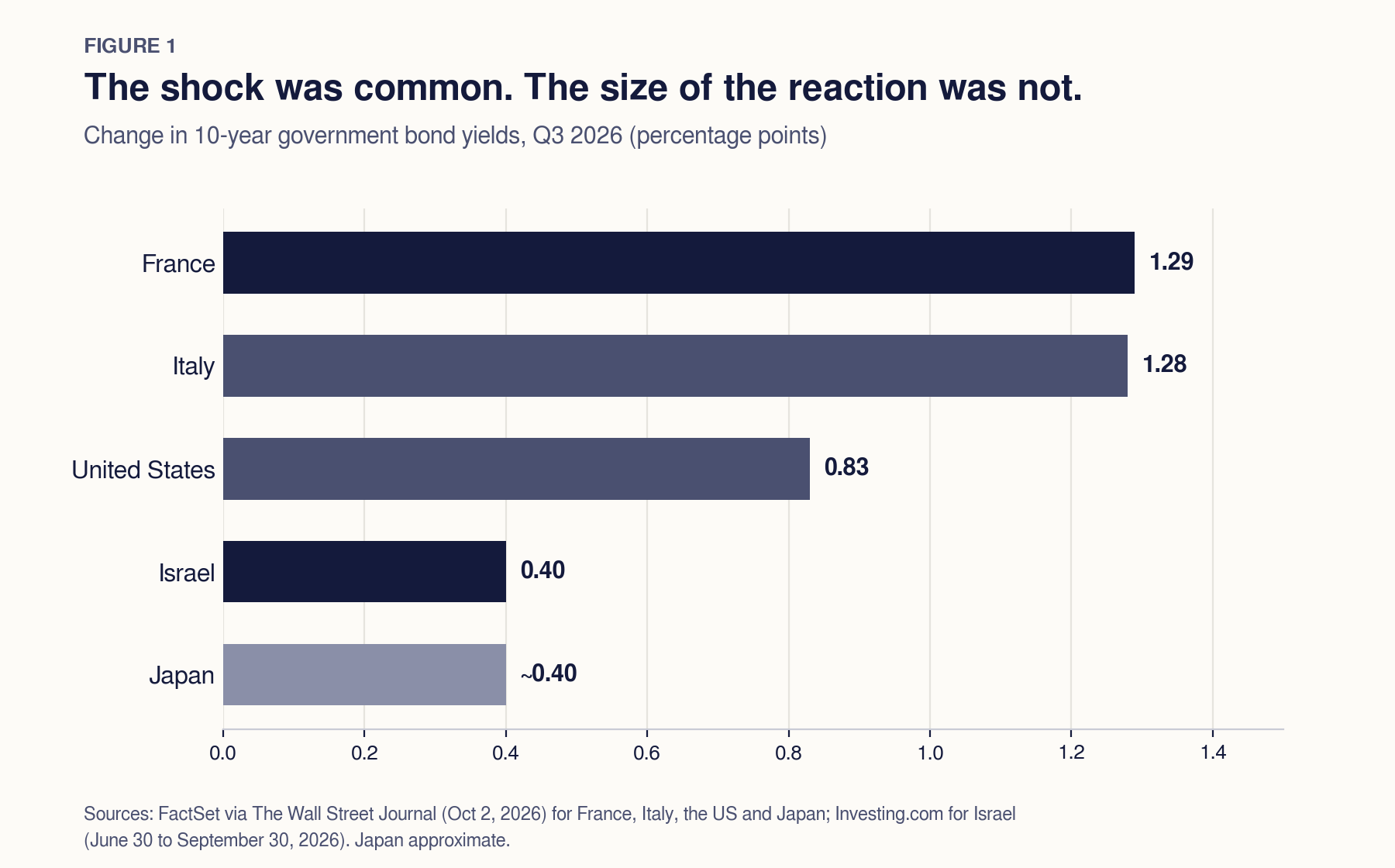
The shock was common to all. The size of the reaction was not. For investors evaluating Israeli government and corporate bonds, the useful question is what separates the sovereigns the market is penalizing from the ones it is not, and where Israel sits.
Why rising rates hurt indebted governments
Governments rarely repay debt. They refinance it. When a bond matures, the treasury issues a new one at the prevailing market rate. A higher rate does not change the cost of existing bonds, but it raises the cost of every bond issued to replace them.
The cost of higher rates therefore arrives gradually and compounds. The pace depends on the average maturity of the debt: long-dated debt reprices slowly, while short-term bills reprice quickly.
France illustrates the process. It is paying an average of 3.55% on new medium- and long-term issuance in 2026, up from 3.14% in 2025. It has more than $1 trillion of debt maturing by 2030, and a study commissioned by the finance ministry projects that debt-service costs will rise 59% over that period.
Three effects follow:
The interest bill grows. The larger the stock of debt, the more each basis point costs. Interest becomes one of the largest lines in the budget.
Other spending is squeezed. Money spent on interest is not available for defense, social programs, or tax relief. Closing the gap requires spending cuts or tax increases, both politically difficult.
The risk premium can feed on itself. If investors doubt a government's ability to stabilize its debt, they demand higher yields. Higher yields raise the deficit, which reinforces the doubt. This is the dynamic the market is now testing in France.
Debt levels matter less than interest rates relative to growth
The headline debt-to-GDP ratio is the most cited number in sovereign analysis, but it does not determine whether debt is sustainable. The direction of the ratio depends on three variables: the average interest rate the government pays on its outstanding debt (r), often called the effective or implicit rate, the nominal growth rate of the economy (g), and the primary balance, which is the budget balance before interest payments.
The standard relationship is:
Δd ≈ (r − g) × d − pb
where d is the debt-to-GDP ratio and pb is the primary balance as a share of GDP.
When r is below g, the economy grows faster than the interest bill, and a country can run a modest primary deficit while its debt ratio holds steady or falls. When r rises above g, the debt ratio rises on its own unless the government runs a primary surplus. Today's market yields are not the same as r. They set the cost of new borrowing and feed into the effective rate gradually, as older debt matures and is refinanced. The rate on new issuance shows where r is heading; the effective rate shows where it is now.
This is the core of France's problem. Real growth is projected at 0.6% in 2026, and INSEE expects inflation to average about 2.1%, so nominal growth is under 3%. At the same time, France is refinancing at an average of 3.55% on new medium- and long-term debt, more than it paid on much of the debt now maturing, so its effective interest rate is rising. The risk is that the effective rate eventually overtakes nominal growth as higher-cost debt replaces older issuance. France also runs a primary deficit, so both terms push the debt ratio higher. The finance ministry's study projects the deficit could reach 6.8% of GDP by 2030. An OECD simulation that assumes no significant fiscal adjustment shows the debt ratio rising from about 119% of GDP today to around 200% by 2050.
Israel's numbers on the same framework are different. The Bank of Israel's July 2026 staff forecast projects real growth of 4.0% in 2026 and 5.5% in 2027, with 2026 inflation of 1.8%. That implies nominal growth close to 6% this year. The government's interest expenses equaled about 4.1% of its debt in 2025, a rough measure of the effective fiscal interest rate that includes the cost of subsidized non-tradable debt, and new 10-year borrowing currently costs about 4.2%. Other forecasters are more cautious: the IMF projects 3.5% real growth in 2026, with inflation slightly above 2%, and Moody's projects 3.7%. Even at the low end, nominal growth stays above both the effective rate and the current cost of refinancing. With an average maturity of about 8.3 years, higher market rates would take years to work through to the effective rate. The gap gives Israel room that France does not have.
Two qualifications apply. The Bank of Israel notes that a significant portion of recent growth reflects foreign production by global firms operating in Israel, which overstates the strength of the broader economy. The forecast has also moved with the security situation: the 2026 growth projection was 5.2% in January, 3.8% in March after renewed fighting, and 4.0% in July.
Four countries, one shock
The United States and Japan are useful reference points. Both carry more debt relative to GDP than Israel, and both faced the same global shock as France, yet the market treated each of them differently. Comparing the four shows what investors are actually pricing: not the level of debt alone, but the size of the deficit, how quickly the debt reprices, who holds it, and whether the country controls its own currency. Ranked by debt level, the order is Japan, France, the United States, and Israel. Ranked by how hard the market has pressed, France comes first, and Japan, despite the highest debt, saw the smallest yield increase in the G7 last quarter.
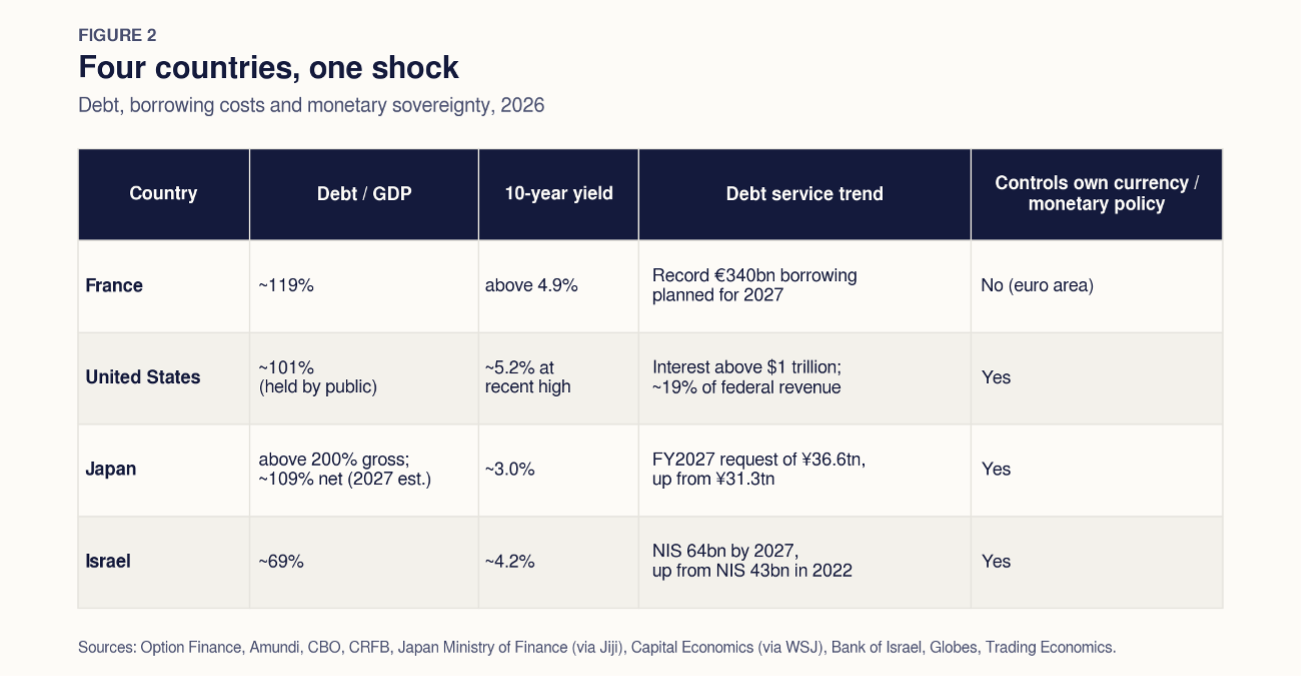
France: every factor points the same way. It combines high debt, a 5.4% deficit, a primary deficit, and no independent monetary policy, and its parliament has repeatedly failed to pass spending cuts ahead of the April 2027 election. The euro area is better equipped to contain disorderly market stress than it was a decade ago, but ECB support is neither automatic nor unconditional.
United States: a budget squeeze, not a funding crisis. It runs a 5.8% deficit with a rising interest bill, but it borrows in the reserve currency and controls its own central bank. Its shorter average maturity means higher rates reach the budget faster than in France or Japan.
Japan: the most debt, the smallest reaction. Japanese yields rose only about 0.4% last quarter. Net of the government's financial assets, debt is about 109% of GDP, and its deficit is projected at about 2% of GDP in 2026, against 5.4% for France and 5.8% for the US. The market is pricing trajectory, not just level.
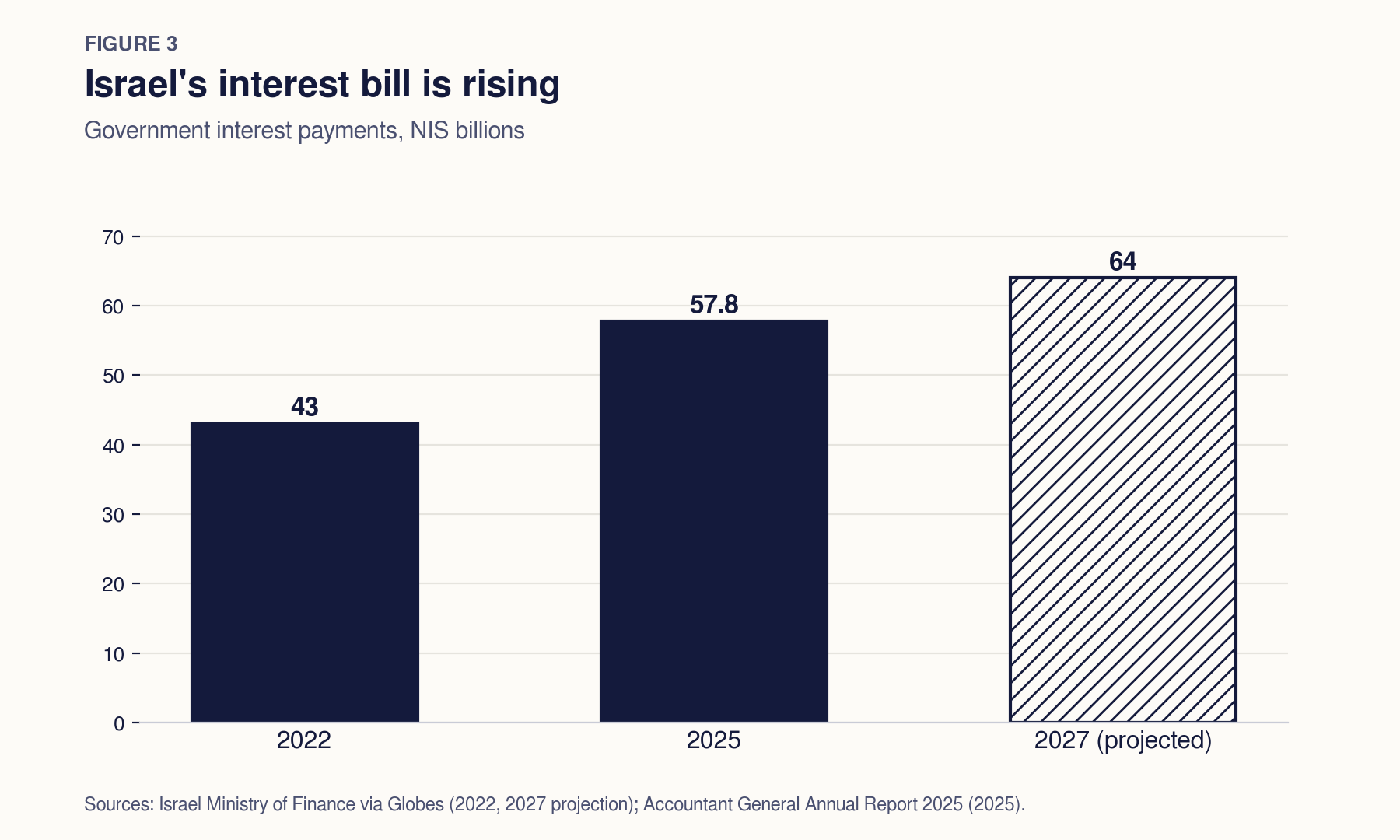
Israel: moderate debt, rising cost. The debt ratio rose from about 60% before the war to about 69%, where the Bank of Israel expects it to stabilize through 2027. Interest costs reached 8.9% of government spending in 2025, up from 8.1% in 2024.
The same global shock produced four different outcomes because each country brought different domestic conditions to it: the size of its deficit, how quickly its debt reprices, whether it controls its own currency, and who holds its bonds. The last of these is the least visible in headline figures and one of the most important in a selloff. It is also where France and Israel differ most.
Who owns the debt
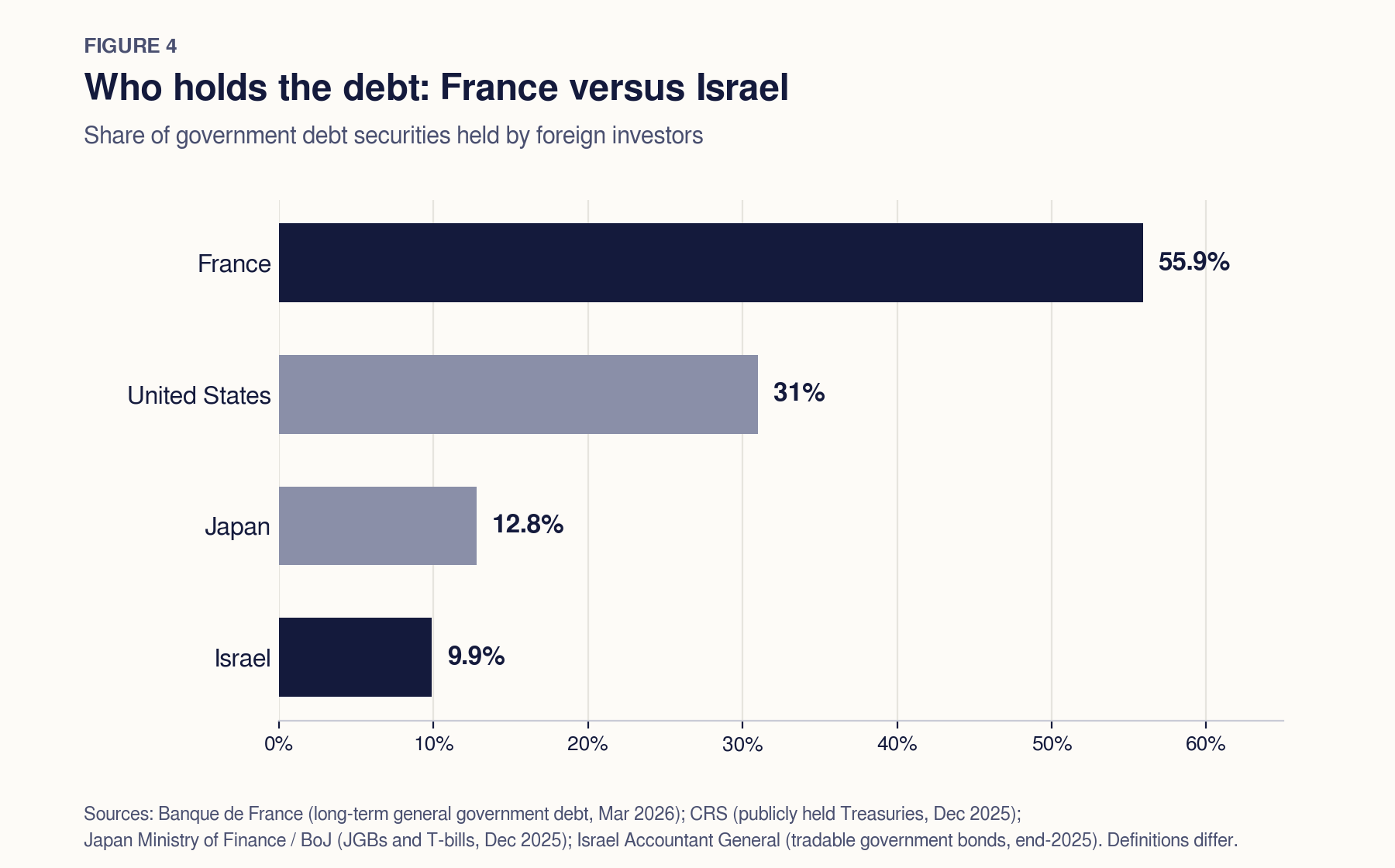
The composition of a country's bondholders shapes how it responds to stress. Nonresident investors hold roughly 56% of France's long-term government debt, and they can reduce exposure quickly when risk rises. France's other traditional buyers have also pulled back. The Bank of France is letting its holdings run off as they mature, and Japanese asset managers have stepped back. Hedge funds have filled part of the gap, but they are short-term holders, and the unwinding of their positions amplified the recent selloff.
Israel is in a different position. Its government debt is held mainly by Israelis and denominated mainly in shekels. According to the Accountant General's 2025 annual debt report, shekel-denominated tradable bonds make up about 61% of the government's debt, non-tradable bonds about 25%, and foreign-currency debt about 14%. The non-tradable portion is held almost entirely by domestic pension funds and insurance companies under long-standing arrangements.
Within the tradable market, foreign investors held about 9.9% at the end of 2025, compared with 9.6% a year earlier. Pension and provident funds held about 33.5%, and the Bank of Israel about 7.7%. Bank of Israel data show that Israeli residents held about NIS 519 billion of tradable government bonds at the end of the second quarter of 2026, of which roughly 71% sat with institutional investors.
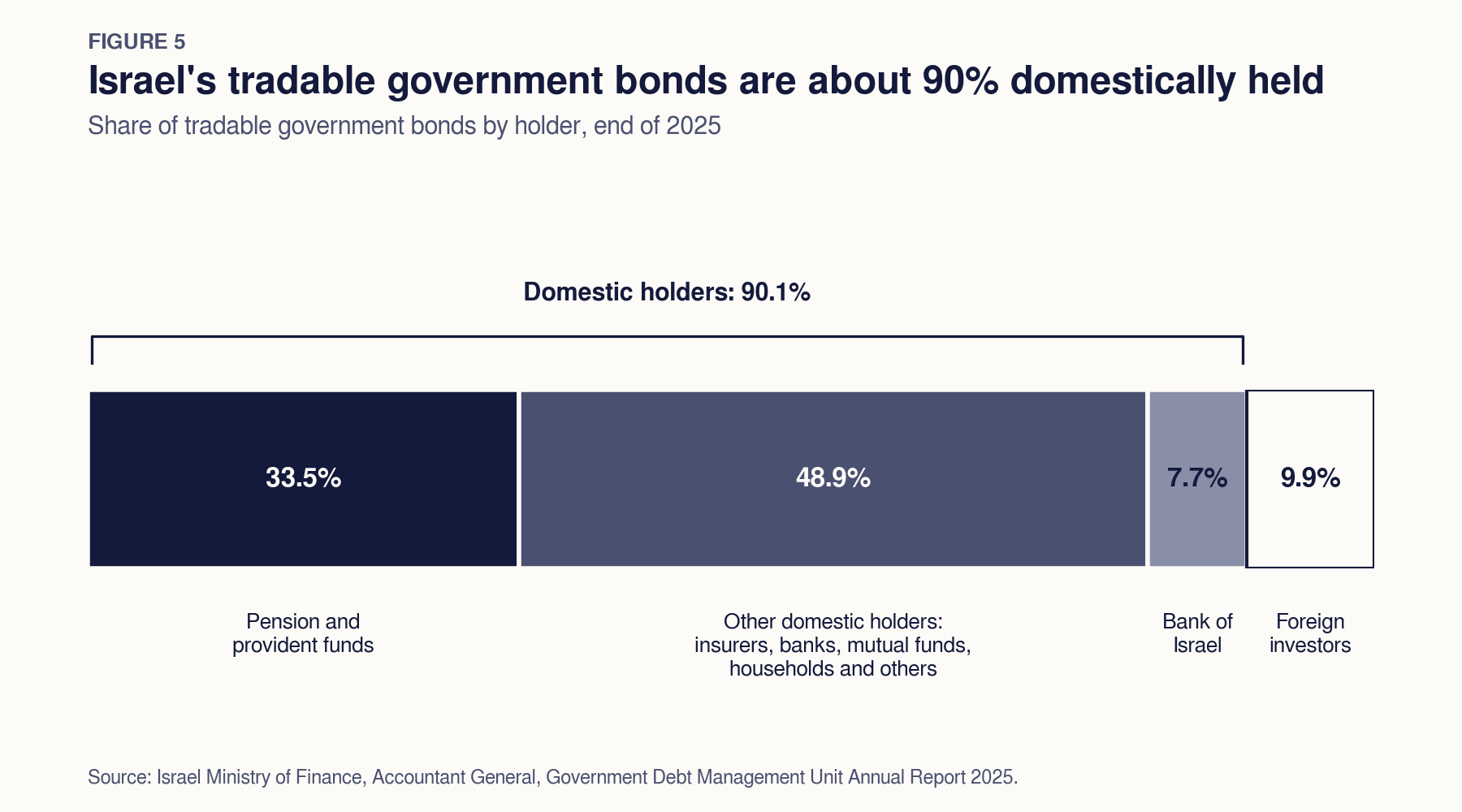
This ownership structure follows from how Israelis save. Pension contributions are mandatory for salaried workers, so new money reaches pension funds and insurers every payroll cycle. Those institutions manage long-dated liabilities and need long-dated shekel assets to match them, and government bonds are the largest pool of such assets. Their demand is not fixed, since they still respond to relative yields, global markets, and their own allocation decisions. But it is recurring, and it does not leave the country when sentiment turns.
This matters in three ways:
Funding stability. When foreign investors sell, domestic institutions are the natural buyers. Israel financed most of its wartime borrowing in its domestic market.
Currency. About 86% of the debt is in shekels, a currency Israel controls. The government does not need foreign currency to service most of its obligations, and a weaker shekel does not raise the cost of most of its debt. France borrows in euros, which it uses but does not control.
Market behavior. With foreign holders at about a tenth of the tradable market, foreign flows are a marginal rather than dominant influence on Israeli government bond prices. Pricing and liquidity are set largely by domestic institutions, so market moves reflect their allocation decisions as much as global sentiment.
Israel also retains access to foreign markets when it chooses to use them: its January 2026 dollar issue of $6 billion drew roughly $36 billion of orders, at the tightest spreads since the war began.
A domestic base does not remove risk. It concentrates exposure in a small number of local institutions that also hold much of Israel's corporate debt and equity, so losses on government bonds fall on Israeli household savings. It does not protect against a sustained rise in rates, and it depends on those institutions continuing to allocate to government debt rather than to foreign assets. What it reduces is the risk of a sudden withdrawal of foreign demand, one factor that has amplified the pressure on French spreads.
What to watch in Israel
Four indicators will show whether Israel's position is improving or eroding.
The deficit path. The 2026 deficit target was raised to 5.1% of GDP in March. The Bank of Israel's July forecast puts the deficit at 4.9% in 2026 and 4.2% in 2027, provided defense spending stays within the budget's reserve, with the debt ratio stabilizing near 69%. Stabilization is now the baseline. A declining debt path, which the Bank of Israel has recommended, is not yet in the forecast.
The long end of the curve. Short-term government yields have returned to pre-war levels, while long-term yields remain elevated. That gap partly reflects the premium investors demand for holding Israeli risk over longer horizons, making the long end one useful market measure of fiscal confidence. The same measure is rising globally: San Francisco Fed calculations show the extra return investors demand to hold long-term US bonds increasing beyond what movements in short-term rates would explain.
Imported pressure. Not every move in Israeli yields originates in Israel. In France, roughly half of the 100 basis point rise in 10-year yields since August reflected global factors rather than French fiscal news. Israeli long-term yields are similarly exposed to US Treasuries, so separating global moves from domestic ones matters when judging what the market is saying about Israel itself.
Credit ratings. Moody's and S&P both currently maintain stable outlooks on Israel's sovereign rating, while Fitch's outlook remains negative. Any change in that direction would affect both sovereign and corporate borrowing costs.
These indicators matter beyond government bonds. The sovereign curve is the base rate against which much Israeli corporate debt is priced, so a rise in long-term government yields can tighten financing conditions for Israeli companies even when their own credit quality has not changed. When corporate bond prices move, investors need to distinguish between a global duration shock, a change in Israeli sovereign risk, and deterioration in an individual issuer's fundamentals.
The Bank of Israel's next staff forecast is due with its October 21 interest rate decision.
Conclusion
The end of near-zero rates is testing every indebted government, but not equally. As in the third-quarter selloff, the shock is common and the reaction is not. The market is not penalizing France for its debt level alone. It is penalizing the combination of high debt, weak growth, rising refinancing costs, a persistent primary deficit, majority foreign ownership, no independent monetary policy, and a political system that has repeatedly failed to pass deficit reductions. Japan, with far more debt but a small deficit and a domestic investor base, was penalized least.
Israel differs from France on most of these dimensions. Its debt ratio is moderate, nominal growth currently exceeds its effective interest rate, and its bondholders are largely domestic. Its weak point has been direction: wartime deficits raised the debt ratio by roughly nine percentage points. The Bank of Israel's baseline now shows that increase stopping, conditional on defense spending staying within budget.
For investors in Israeli fixed income, the deficit path and the long end of the curve are the indicators that will show whether that baseline holds. The recent selloff suggests that governments able to present credible deficit plans will be better positioned to absorb global rate shocks than those that cannot.
About Kotel Investment Management: We serve as a bridge between global capital and Israeli markets. Our research covers Israel's economy, financial system and markets for institutional investors, family offices and advisors.
This content is for informational and educational purposes only. It does not constitute investment, legal or tax advice, or an offer to sell or a solicitation of an offer to buy any securities. Figures are as of the dates cited and may change. Forecasts referenced are those of the third parties named and do not necessarily reflect the views of Kotel Investment Management.
Sources
France
Option Finance: French sovereign risk returns to euro-crisis levels (Oct 1, 2026)
Option Finance / Allianz Global Investors: The OAT-Bund spread (Oct 1, 2026)
Trading Economics: French bond yields at 2002 high (Oct 1, 2026)
Amundi: France's fiscal policy in focus
INSEE inflation forecast, September 2026 note de conjoncture (via Tout sur mes finances)
Banque de France: Émission et détention de titres français, 2026-Q1 (Jul 2026)
Global and G7
United States
House Budget Committee: CBO baseline, February 2026
CRFB: CBO analysis of higher interest rates
Trading Economics: 10-year Treasury yield holds near 2007 highs (Sep 30, 2026)
CRFB: 1% higher interest rates add $3.5 trillion in debt
Japan
Jiji Press: Japan eyes record ¥36tn for debt servicing (Aug 25, 2026)
Reuters via Zawya: Japan bond auction faces scrutiny as yields rise
Israel
Israel Ministry of Finance, Accountant General: Government Debt Management Unit Annual Report 2025
Bank of Israel: Monetary Committee decision and staff forecast, July 6, 2026
Bank of Israel: Monetary Committee decision and staff forecast, March 30, 2026
Bank of Israel: Monetary Committee decision, September 1, 2026
Bank of Israel: The public's financial assets portfolio, Q2 2026 (Sep 23, 2026)
Bank of Israel: Statistical Bulletin for 2025
IMF: Executive Board concludes 2026 Article IV consultation with Israel (Jul 1, 2026)
Globes: Bank of Israel on the amended 2026 budget (Mar 11, 2026)
Globes: Bank of Israel cuts interest rate again (Jul 2026)
Globes: Interest payments on government debt
The Jerusalem Post: Moody's forecast for Israel's economy