From Geopolitics to the Yield Curve: What the Bank of Israel’s Midyear Report Tells Us

The Bank of Israel’s new monetary policy report points toward lower interest rates, contained inflation, and recovering growth. Beneath that constructive outlook sits a harder question: Can the Bank keep cutting rates if geopolitics leads to higher defense spending, greater government borrowing, renewed inflation, or shekel weakness?
Here is what we at Kotel see.
The Bank of Israel released its report for the first half of 2026 against a backdrop that would have seemed implausible a few years ago. Israel absorbed a direct military confrontation with Iran, a first-quarter economic contraction, substantial reserve mobilization, and a rising defense burden.
Yet inflation is near the middle of the Bank’s target range. The shekel remains materially stronger than a year ago. Israel’s risk premium has returned to roughly its pre–October 7 level. And the Bank cut its policy rate three times in six months.
That combination is the starting point for understanding Israeli fixed income today.
The contrast the report understates
The report’s opening contains its most important fact, almost in passing: Israeli inflation declined “in contrast with the global trend.” US inflation accelerated to 4.2% in May, up from 2.7% six months earlier. Eurozone inflation reached 3.2%. The European Central Bank raised rates in June, the Federal Reserve remained on hold, and investors increasingly expect interest rates across major economies to stay higher.
Israel moved in the opposite direction.
Israeli inflation was 1.9% in May, while the Bank cut rates in January, May, and July, bringing its policy rate to 3.5%. The June CPI, released after the report’s data period ended, showed inflation falling further to 1.6% — its lowest level since 2021.
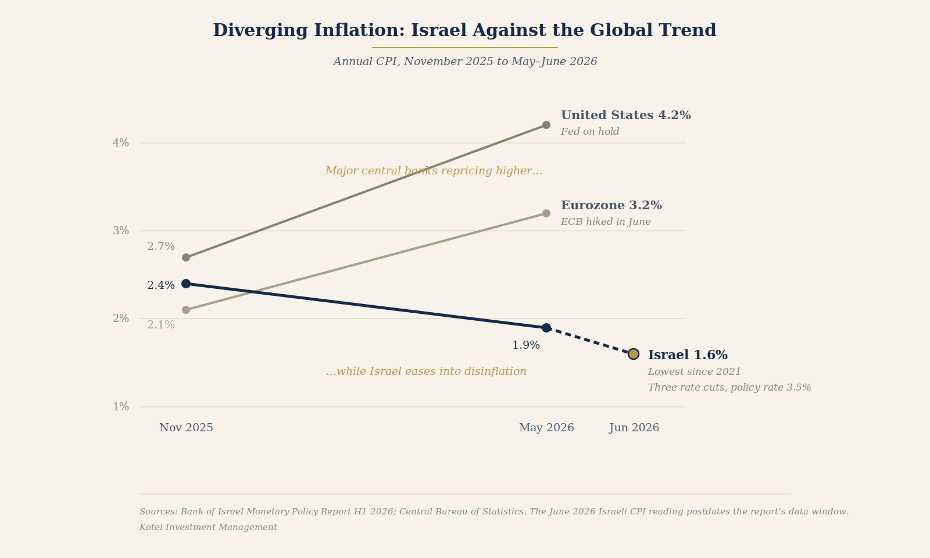
Figure 1. Annual CPI, November 2025 to May–June 2026. Israeli inflation declined while US and eurozone inflation accelerated.
The country closest to the geopolitical shock is easing monetary policy while much of the developed world is confronting renewed inflation. That reflects several factors: the shekel’s strength, stable inflation expectations, substantial domestic demand for government debt, and the decline in energy prices after the confrontation.
It also demonstrates a point we make often: Israeli fixed income does not simply mirror global markets. It has its own economic and interest-rate cycle.
The Bank’s baseline
The Bank’s July forecast can be summarized in three parts.
First, the war made 2026 worse. Expected growth was reduced from 5.2% to 4.0%, while the projected deficit increased from 3.9% to 4.9% of GDP.
Second, it did not shake the Bank’s confidence in inflation. Inflation is projected at 1.8% in both 2026 and 2027.
Third, the recovery has been delayed rather than cancelled. The Bank raised its 2027 growth forecast from 4.3% to 5.5%.
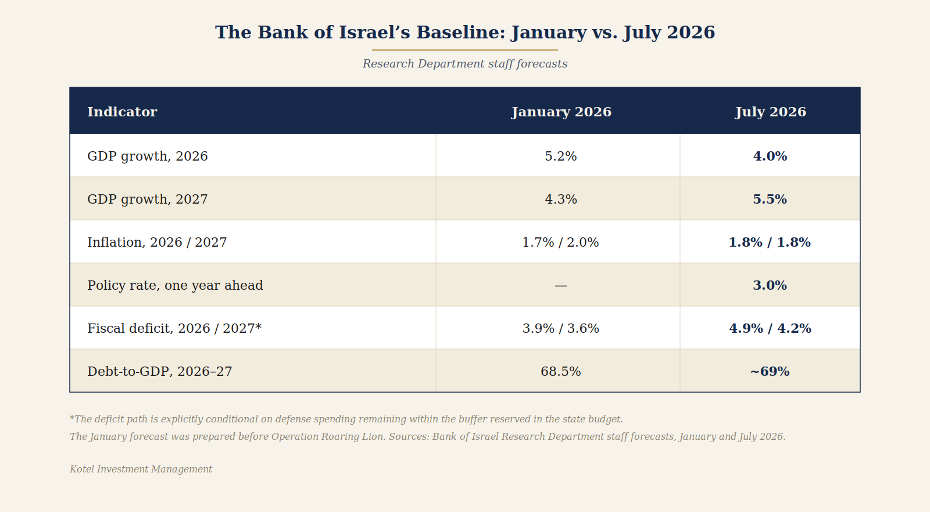
Figure 2. Bank of Israel Research Department staff forecasts, January vs. July 2026.
For bond investors, the most important number in the table may be the deficit — because deficits are paid for by selling bonds. A deficit of 4.9% of GDP means the government must borrow roughly that amount this year, and the bond market must absorb the supply. The forecast also assumes that defense spending stays within the buffer already reserved in the budget. The NIS 25 billion increase under discussion would break that assumption and push the deficit to roughly 5.5%.
The growth picture is more encouraging. The economy contracted at a 3.8% annualized rate in the first quarter, but that was milder than forecast and less severe than the disruption from the earlier confrontation with Iran in 2025. Each shock has done less damage than the one before it — which may suggest improved preparation and resilience, although two episodes are not enough to establish a lasting pattern. Early second-quarter data points to a recovery already underway.
The inflation picture is genuinely mixed. Headline inflation looks controlled. But the forces holding it down — a strong shekel and lower energy prices — are external, and they can reverse. The domestic pressures run the other way: unemployment is low, wages have been rising quickly, and housing costs are climbing. These are the kinds of pressures that do not disappear when oil prices fall.
That mix matters because it pulls the two ends of the bond market in different directions. Today's low inflation supports the Bank's rate cuts, which help short-term bonds. Tomorrow's borrowing needs and domestic price pressures weigh on long-term bonds. The rest of this article is about that tension.
How geopolitics reaches the bond market
Geopolitics is often treated as a single risk: tensions rise, investors sell Israeli assets, and the shekel weakens.
That can happen, but the full picture is more complicated. Geopolitical developments reach Israeli markets through several different — and sometimes opposing — channels.
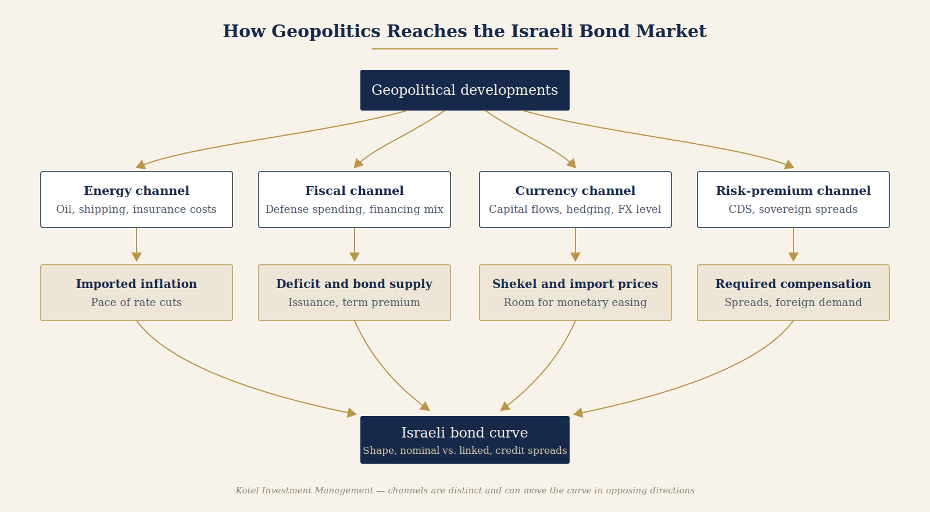
Figure 3. Transmission channels from geopolitical developments to the Israeli bond curve.
The energy channel
Regional escalation can raise oil, shipping, and insurance costs. Because Israel imports many goods and raw materials, those higher costs can eventually reach consumers.
The first half of 2026 provided a clear example. Brent oil began the period near $60 per barrel, briefly traded around $120 during the confrontation, and fell back toward the low $70s by June.
Had oil remained near its peak, the Bank’s rate-cutting path would look very different. Instead, lower oil prices, a stronger shekel, and a decline in Israel’s risk premium helped improve the inflation outlook.
The lesson is that geopolitics does not always produce higher interest rates. It depends on which effect dominates:
If uncertainty reduces spending, hiring, and investment, inflation may weaken and the Bank may cut rates.
If the conflict raises energy, shipping, labor, and production costs, inflation may rise and the Bank may have to hold or raise rates.
The duration of the shock matters as much as the initial event.
The fiscal channel
War raises government spending through military operations, reserve pay, equipment replacement, compensation, and potentially a permanently larger defense budget.
How the government pays for that spending determines the bond-market effect.
If the additional costs are offset through taxes or reductions elsewhere in the budget, the effect on borrowing can remain manageable. If the government finances them by borrowing, it must issue more bonds.
Israel has a substantial domestic investor base for government debt. But additional supply still needs buyers, and those buyers may demand higher yields — especially for longer-term bonds.
The Bank’s report makes this risk explicit. The government is considering up to NIS 25 billion of additional defense spending in 2026, which would bring the defense budget to NIS 183 billion. The Bank estimates that this could:
Increase the deficit from 4.9% to approximately 5.5% of GDP;
Add around 0.3 percentage points to inflation over the following year; and
Increase the government’s borrowing needs.
This is not simply a budgetary detail. It affects both sides of the bond market: the government may need to sell more bonds at the same time that investors become more concerned about inflation.
The currency channel
The shekel appreciated by approximately 10% against the dollar from January through the end of May, when the exchange rate reached NIS 2.8 per dollar. It then weakened to approximately NIS 3.0 in June.
A stronger shekel makes imported goods less expensive and helps lower inflation. That gives the Bank more room to cut rates. A weaker shekel has the opposite effect. Imports become more expensive, inflation can rise, and the Bank’s ability to cut rates narrows.
The Bank identified the shekel’s appreciation as an important reason inflation declined. It also purchased $801 million of foreign currency in May and $1.027 billion in June to preserve orderly market functioning.
In June, however, the trend reversed and the shekel weakend. The June reversal is a reminder that the currency channel runs both ways. Shekel strength helps bonds through lower inflation, but excessive strength can also create difficulties for exporters and the technology sector, particularly since Israeli tech startups predominantly raise money in dollars but pay salaries and other costs in shekels.
The risk-premium channel
A country’s risk premium is the additional return investors demand for accepting its political, economic, and financial risks.
Despite a half-year that included direct war with Iran, Israel's risk premium — measured through credit-default swaps and the spreads on its dollar bonds — returned to roughly its pre–October 7 level.
Before October 7, insuring Israeli government debt against default for five years cost roughly 60 basis points per year. That cost more than doubled during the worst of the multi-front escalation in late 2024, exceeding 150 basis points, and spiked again toward 120 during the confrontations with Iran. By mid-2026 it had returned to the mid-60s — almost exactly where it started. Markets appear to have distinguished between frightening headlines and Israel's actual capacity to service its debt.
That does not mean geopolitical risk has disappeared. Investors may still demand compensation for inflation, government borrowing, and the possibility of another shock. But they are no longer pricing Israel as a steadily deteriorating credit.
Rate cuts do not guarantee lower long-term yields
This is the report’s most important bond-market implication, even though it is never stated directly.
The Bank of Israel’s policy rate has its strongest effect on short-term borrowing costs. It influences overnight rates, deposits, short-term government debt, and bonds with floating interest rates.
A 10-year bond is different. Its yield reflects not only where investors expect the Bank’s rate to go, but also:
Expected inflation;
Government borrowing;
The risk of holding a bond for many years;
The outlook for public debt; and
Global interest rates.
The Bank can therefore cut its policy rate while 10-year bond yields remain unchanged — or even rise.
This has already happened. The Israeli 10-year yield rose by more than 30 basis points from its mid-February low through early April, even while the broader rate-cutting cycle remained in place.
The same tension exists today.
On one side, inflation of approximately 1.8% gives the Bank room to lower its policy rate toward 3.0%. On the other, a 4.9% deficit — and a defense-spending scenario that could raise it to 5.5% — creates the possibility of more borrowing and inflation in the medium-to-long term.
If falling inflation dominates, yields can decline across the market.
If fiscal concerns dominate, short-term yields may fall while long-term yields remain elevated. The difference between short- and long-term yields would then widen, producing what investors call a steeper yield curve.
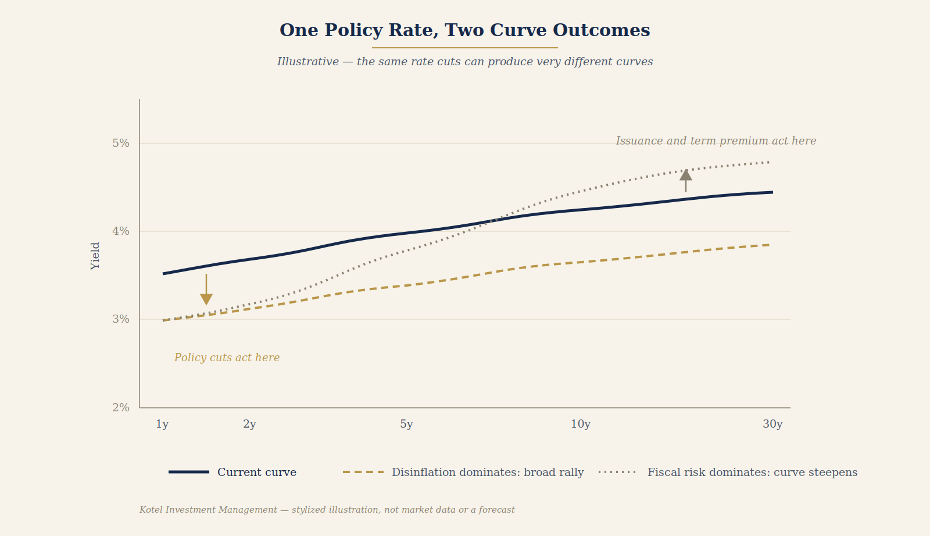
Figure 4. Stylized illustration. Policy cuts act on the front of the curve; issuance and term premium set the long end.
The bull case
Our bullish case begins with inflation.
Inflation fell from 1.9% in May to 1.6% in June, while inflation expectations also declined. The Governor has said that if expectations move toward the bottom of the Bank’s target range, faster monetary easing could become appropriate.
That creates a clear path to additional rate cuts if inflation continues falling. It does not eliminate risks from wages, housing, energy prices, fiscal spending, or shekel weakness, but it gives the Bank room to respond.
A lasting geopolitical de-escalation would strengthen the case further. It could produce:
Lower energy and shipping costs;
Less reserve mobilization;
Stronger economic activity;
Better tax revenue;
A lower risk premium; and
Stronger foreign investment.
If additional defense needs remain within the existing budget or are offset through credible fiscal measures, debt could stabilize near 69% of GDP and the deficit could begin declining in 2027.
In the strongest version of the bull case, the entire bond market benefits. Short-term yields fall as the Bank cuts rates. Long-term yields fall as fiscal and geopolitical concerns ease. Corporate borrowing costs also decline as the economy recovers.
The bear case
The bear case does not require another war. It can develop through a combination of greater defense spending, continued supply constraints, and renewed inflation.
If the proposed NIS 25 billion becomes permanent rather than temporary, investors may question whether Israel can stabilize its debt without higher taxes or cuts to civilian spending.
The government would likely need to issue more bonds. Because Israel’s economy still faces labor and supply shortages, additional government spending could also raise prices rather than simply increasing economic output.
The shekel could make the problem worse. Renewed escalation, domestic political uncertainty, or declines in US equity markets could weaken the currency, raise imported inflation, and cause the Bank to slow or stop cutting rates.
Global markets matter as well. Higher US and European rates make Israeli bonds relatively less attractive unless Israeli yields also rise. Long-term Israeli yields could therefore remain elevated even if domestic inflation stays controlled.
In this scenario, short-term and inflation-linked bonds may prove more resilient than long-term nominal bonds.
The underappreciated outcome
Much of the discussion asks a binary question: Are Israeli interest rates going up or down?
The more useful question is: Which rates?
At the very front of the market, there is no mystery. Israel's overnight benchmark — the SHIR — is set equal to the Bank of Israel's policy rate by construction. When the Bank cuts, the overnight rate moves with it, exactly and immediately.
The divergence begins further out. The Bank can keep cutting because current inflation is low and economic output remains below its longer-term trend. At the same time, investors can demand higher yields on long-term bonds because future defense costs and government borrowing remain uncertain.
Both positions can be correct.
That could produce an environment in which short-term yields decline with the policy rate, long-term yields remain elevated, and inflation-linked and corporate bonds perform differently depending on their maturity and individual characteristics.
In that market, positioning along the yield curve, comparing relative values, and selecting individual securities can matter more than making one broad prediction about rates.
What we see
Our conclusion is bullish, but selective.
Inflation is contained and falling. Expectations remain stable. Israel’s risk premium has normalized. The shekel remains strong on a multiyear basis. The economy has demonstrated an increasing capacity to absorb and recover from severe geopolitical shocks.
The Bank therefore has genuine room to continue cutting rates.
But the strongest version of the bull case depends on three assumptions:
The current geopolitical arrangements hold or improve, either through diplomacy or another kinetic war;
Energy prices remain contained; and
Additional defense spending stays within the budget or is credibly offset.
Those assumptions are reasonable. They are not guaranteed.
We see the clearest support at the short and intermediate portions of the yield curve, where Bank of Israel rate cuts have their most direct effect.
The long end must also reflect the fiscal outlook, future government borrowing, and the additional return investors demand for lending for many years.
Inflation-linked bonds also deserve attention. The Bank’s base case expects continued low inflation, but its defense-spending scenario identifies a meaningful risk that inflation comes in higher. Whether inflation protection is attractive will depend on how much inflation is already reflected in each bond’s price.
The broader lesson matches our view of the Israeli market. Geopolitical events create visible volatility, but the opportunity often lies in their second-order effects — where an event changes financing needs, bond prices, the shape of the yield curve, or corporate-credit quality before the market fully adjusts.
The bottom line
The Bank’s report offers a constructive path: 1.8% inflation, a policy rate moving toward 3.0%, 5.5% growth in 2027, and debt stabilizing near 69% of GDP — all while much of the developed world confronts renewed inflation.
It also identifies the principal threat: a larger defense budget that raises the deficit, adds to inflation, and increases government borrowing.
The policy rate can fall without every bond yield falling with it.
For Israeli fixed-income investors, the next phase will be shaped equally by whether the Bank cuts rates and how geopolitics, fiscal policy, and bond issuance redistribute value across the market.
That is where disciplined, active analysis earns its keep.
Sources: Bank of Israel, Monetary Policy Report for the First Half of 2026 (July 20, 2026); Bank of Israel Research Department Staff Forecast, July 2026; Central Bureau of Statistics, May and June 2026 CPI releases.
About Kotel Investment Management: We serve as a bridge between U.S. capital and Israel’s overlooked fixed income markets, sharing insights and perspective through our research and thought leadership.
This content is for informational and educational purposes only and does not constitute an offer to sell or a solicitation of an offer to buy any securities